AI search
How Google AI Overviews and AI Mode Choose Their Sources
Google AI Overviews and AI Mode choose their sources by running several related searches for the sub-questions behind a query, a technique Google calls query fan-out, and citing indexed, snippet-eligible pages from those results. There are no additional requirements beyond normal Search eligibility, but the pages cited now overlap the top 10 rankings far less than they did a year ago.
- For
- Marketing directors
- Founders
- Anyone who ranks but isn't quoted
 By Noor KhanFounder & CEO, Noorscale
- Published
- Published 8 November 2026
- Updated
- Updated 8 November 2026
- Reading time
- 19 min read
What are Google AI Overviews and AI Mode?
Google AI Overviews and AI Mode are two generative features of Google Search that answer a query with text written by Gemini and cite the web pages the text was drawn from. AI Overviews sit above the results for some queries; AI Mode is a separate conversational tab. If you've watched an AI Overview appear above a page you spent a year getting to rank, you already know why the distinction matters: the two features don't pick their sources the same way, and the one you're losing clicks to may not be the one you can win. How often they appear moves, too. In Semrush's 10M-keyword sample, an AI Overview appeared on 6.49% of queries in January 2025, 24.61% in July 2025 and 15.69% in November 2025. For business and buying prompts the picture is starker: 86.7% triggered one in April 2026 (Peec). So if your market is the kind where people compare before they buy, assume the Overview is there.
| AI Overviews | AI Mode | |
|---|---|---|
| Where it appears | Above the ordinary results, on some queries | A separate conversational tab in Search |
| When it triggers | Google's choice per query; the rate moved between 6% and 25% of queries across 2025 (Semrush) | When a person opens the tab, or Google offers it for a question |
| Sources cited per answer | About 3 (Semrush, July 2025) | About 7 (Semrush, July 2025) |
| Follow-up questions | Not kept; each search starts over | Kept in a thread, and each turn can cite different pages |
What is a Google AI Overview?
A Google AI Overview is a generated summary that Google shows at the top of a results page for some queries, with links to the pages the summary was built from. It isn't on every query, and it doesn't stay put: the appearance rate in Semrush's sample went from 6.49% to 24.61% to 15.69% across 2025, which is Google turning the dial, not your site changing. Google's own guidance, "Succeeding in AI search" (May 2025), says AI features suit longer, more specific follow-up questions, and that tells you where to look for them: not the two-word head term, but the question a person asks after it. The summary is the part people read. The links are the part you're competing for.
What is Google AI Mode?
Google AI Mode is a conversational search tab in which Gemini answers a query in full, keeps the thread for follow-up questions, and cites its sources inside the answer. Google's AI Mode launch post (2025) says it "is rooted in our core quality and ranking systems", and that when Google lacks high confidence in a generated answer, it shows web results instead. Both lines are worth holding onto. The first means the ranking work you've already done isn't wasted in AI Mode. The second means there are queries where no generated answer appears at all, and your ordinary result is what the person sees. What AI Mode adds is the thread: a person can ask, refine, and ask again, and each turn can cite a different set of pages. How both features decide what to cite is the next question, and it's the one that changes the work.
How do AI Overviews and AI Mode choose which pages to cite?
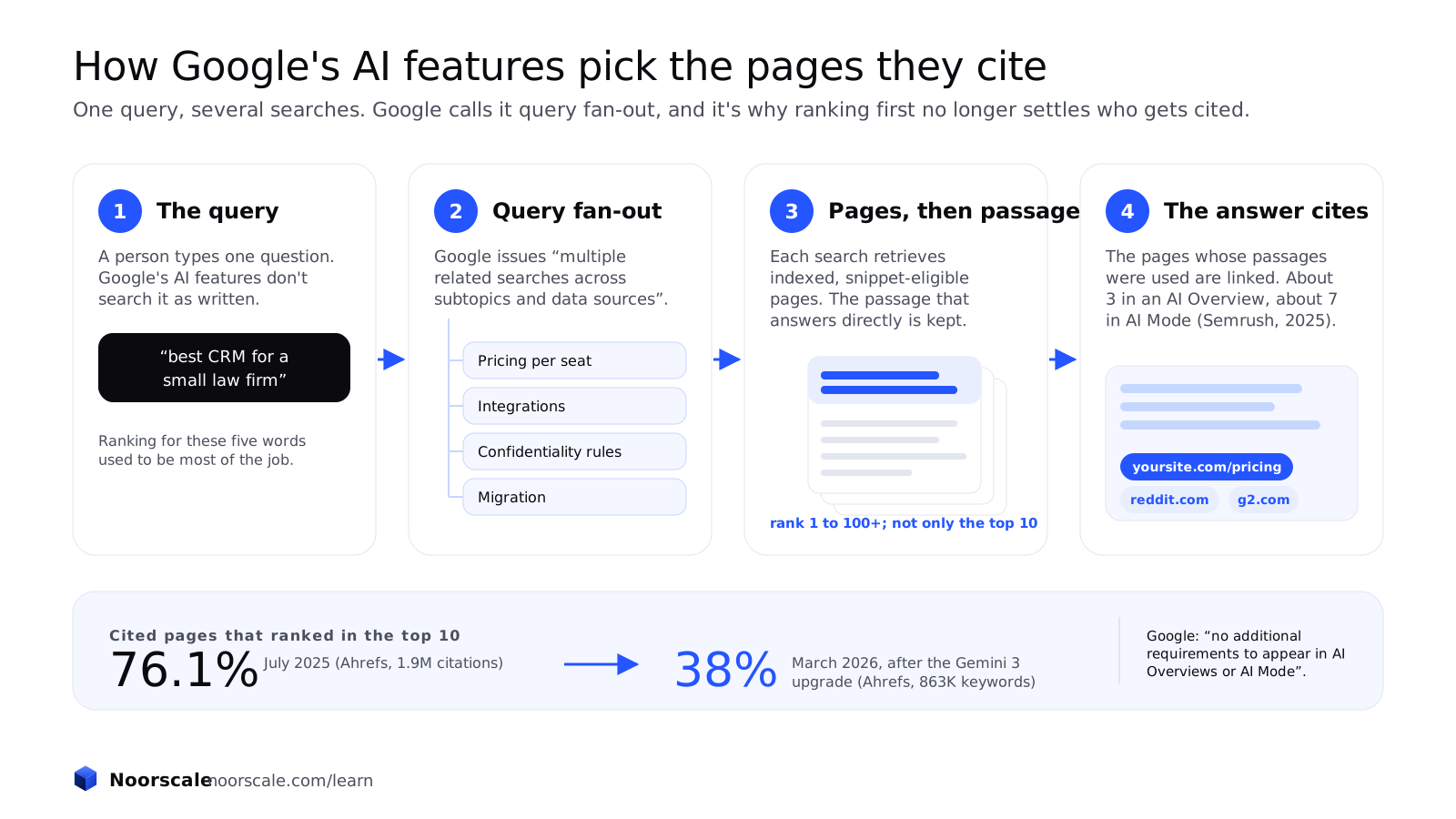
AI Overviews and AI Mode choose which pages to cite in four steps: they break the query into related sub-questions, run searches for each across Google's index, select passages from indexed, snippet-eligible pages that answer those sub-questions, and attach the pages whose passages were used as citations. Selection sits on top of ranking rather than replacing it. AI Mode "is rooted in our core quality and ranking systems" (Google, 2025), and Google's "Succeeding in AI search" (May 2025) asks for unique, non-commodity content, which is the same thing it has asked of Search for years. Here are the four steps, with what a page needs to survive each one.
Each step filters the set of pages a little further, and a page can fall out at any of them.
- Fan-out. The query becomes several sub-questions. Your page needs to answer at least one of them specifically, not the head term in general.
- Retrieval. Each sub-question runs as a search against Google's index. Your page needs to be indexed and to rank somewhere for that sub-question, not necessarily in the top 10.
- Passage selection. The passage that answers the sub-question directly is kept. Your page needs that answer in one liftable block, not spread across a section.
- Citation. The pages whose passages were used are linked. Your page needs no snippet controls that stop Google from showing it.
Step one is the one that changes everything, so it gets its own section.
How does query fan-out work in Google AI search?
Query fan-out works by taking one query and issuing multiple related searches across subtopics and data sources, then assembling the answer from the pages returned for each of those searches rather than from the single results list a person would see. That is Google's own description: both features may use a "query fan-out" technique, "issuing multiple related searches across subtopics and data sources" (Google Search Central, AI features and your website). Ahrefs' March 2026 update adds that fan-out "may now play a larger role" in which pages are cited. Here is what it looks like for a query a buyer might type.
A query such as "best CRM for a small law firm" fans out into sub-questions, and each one pulls its own set of pages.
- Pricing: which CRMs charge per seat, and what a five-person firm pays.
- Integrations: which ones connect to the practice management and email tools the firm already uses.
- Compliance: how each one handles client confidentiality and data retention.
- Migration: what moving from a spreadsheet or an older CRM involves.
Your page might rank third for the head query and answer none of the four. Another page might rank fortieth and answer the compliance question better than anyone, and that is the page that gets cited for it. Google has said what it requires to be in the running, and it is less than most guides claim.
What does Google say a page needs to appear in AI Overviews and AI Mode?
Google says a page needs nothing beyond normal Search eligibility to appear in AI Overviews and AI Mode: it must be indexed and eligible to be shown with a snippet, and no special schema.org structured data is required. The exact words, from Google Search Central's "AI features and your website", are that there are "no additional requirements to appear in AI Overviews or AI Mode", and that there is "no special schema.org structured data that you need to add". If a proposal on your desk says otherwise, that's the line to read back to whoever wrote it. Here is everything Google actually names.
Google's eligibility list for AI features is short, and each item below is in Google's own words.
- Indexed: the page is in Google's index, the same as for any search result.
- Eligible to be shown with a snippet: not blocked by nosnippet, and not limited by a restrictive max-snippet value, because Google says such controls limit how content is featured in AI features.
- Unique, non-commodity content, which Google's "Succeeding in AI search" (May 2025) asks for, and which is a quality bar rather than a technical one.
- No llms.txt needed: Google says it ignores the file.
Eligibility is not selection, though. Almost every indexed page is eligible; a handful are selected. The overlap data shows how wide that gap has become.
How much do AI Overview citations overlap with the top 10 rankings?
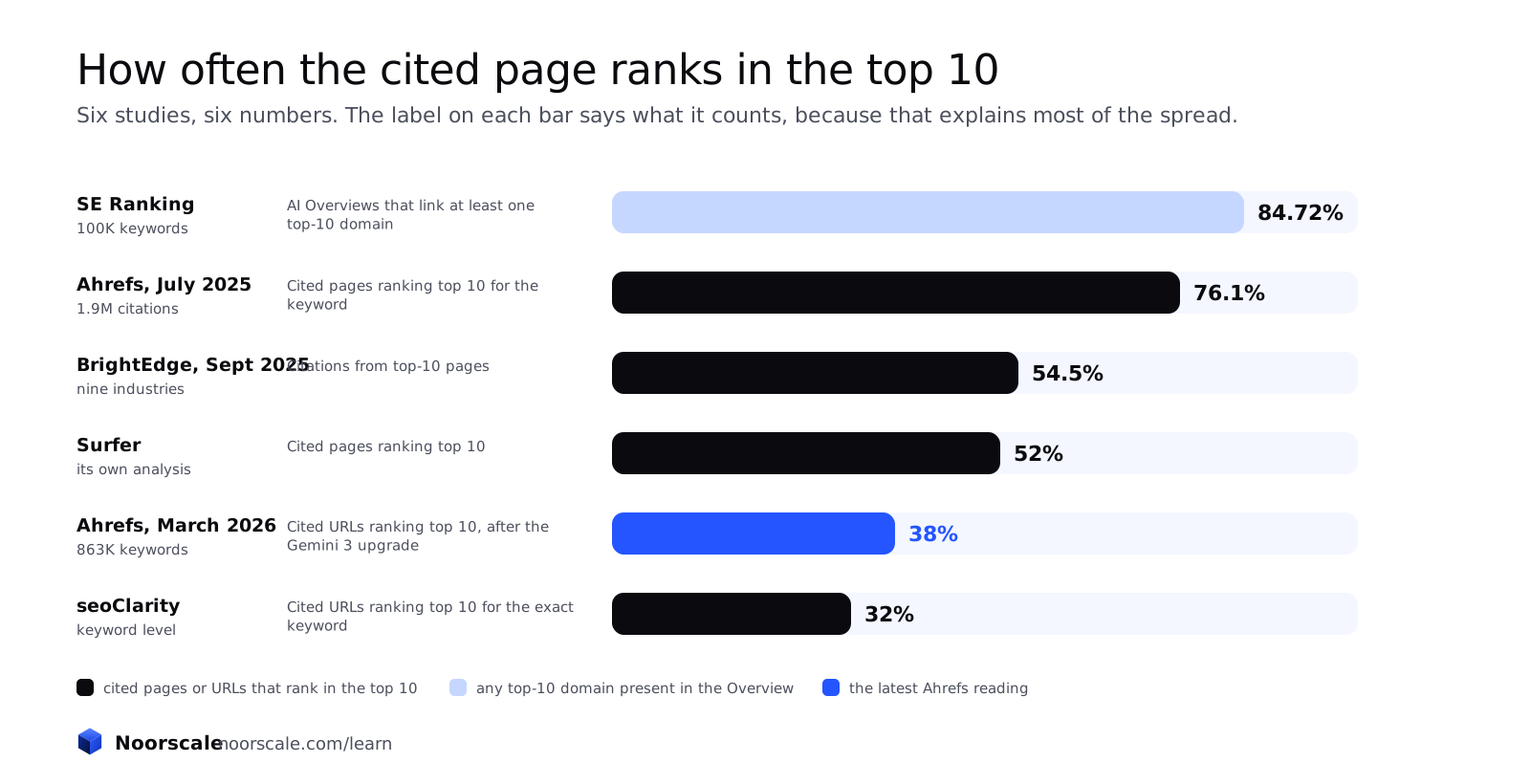
AI Overview citations overlap with the top 10 rankings less than they used to: 76.1% of cited pages ranked in the top 10 in July 2025, and 38% did by March 2026, after the Gemini 3 upgrade to AI Overviews (Ahrefs). That single pair of numbers is the reason this page exists. A year ago, ranking well was most of the job. Now it's a little over a third of it. Every published study is in the table below with its sample and its unit of measurement, because the figures look contradictory until you read what each one counts.
| Organisation and date | Sample | What it counts | Overlap |
|---|---|---|---|
| Ahrefs, July 2025 | 1.9M citations across 1M AI Overviews | Cited pages ranking in the top 10 for the keyword | 76.1%; median rank of the first citation was 2 |
| Ahrefs, March 2026 | 863K keywords, 4M cited URLs | Cited URLs ranking in the top 10 | 38% |
| seoClarity | Its own analysis | Any top-10 domain present in the Overview (AIO level) against cited URLs ranking top 10 (keyword level) | About 90% at AIO level; 32% at keyword level |
| Surfer | Its own analysis | Cited pages ranking in the top 10 | 52% |
| BrightEdge, 2025 | Nine industries, tracked through the year | Citations from top-10 pages | About 17% early in 2025; 54.5% by September 2025 |
| SE Ranking | 100K keywords | AI Overviews linking at least one organic top-10 domain | 84.72% |
| Semrush, July 2025 (AI Mode) | 5,000 keywords | Cited domains, and cited URLs, in the top 10 | 51% of domains; about a third of URLs |
Two readings survive the table. Rankings still matter: most Overviews link at least one top-10 domain, and the median first citation in the Ahrefs sample ranked second. And the share of citations from outside the top 10 has grown, so a ranking is a ticket into the room rather than a seat at the table. The numbers look like they disagree until the method is read.
Why do the overlap studies disagree?
The overlap studies disagree because they measure different units at different times: a study that counts whether any top-10 domain appears in an AI Overview reports about 85 to 90%, a study that counts how many cited URLs rank top 10 for the exact keyword reports 32 to 38%, and the figures measured after the Gemini 3 upgrade are lower than those measured before it. Three things pull the numbers apart. The unit: seoClarity's about 90% at the AI Overview level against 32% at the keyword level is the cleanest example of the same data read two ways. The scope: Semrush's AI Mode figures run 51% for domains and about a third for URLs, because a domain can be in the top 10 with one page and cited for another. The date: Ahrefs' 76.1% was measured before the Gemini 3 upgrade and its 38% after, while BrightEdge's figure rose from about 17% to 54.5% over 2025, which shows the number also moves when Google changes its own systems. None of the studies is wrong. Each one answers a slightly different question, and AI Mode is where the gap is widest.
How does AI Mode choose sources differently from AI Overviews?
AI Mode chooses sources differently from AI Overviews in two measurable ways: it cites about 7 domains per answer against about 3 for AI Overviews, and only about a third of its cited URLs and about half of its cited domains overlap the top 10 for the query (Semrush, 5,000 keywords, July 2025). A conversational answer fans out further, so more pages from further down the results get pulled in, and that is the whole difference in one sentence. Google's own statement that AI Mode falls back to web results when it lacks high confidence (Google, 2025) cuts the other way: on the queries where it isn't sure, nobody gets cited.
| AI Overviews | AI Mode | |
|---|---|---|
| Domains cited per answer | About 3 | About 7 |
| Cited URLs in the top 10 for the query | Not reported in the same study | About a third |
| Cited domains in the top 10 for the query | Not reported in the same study | About half |
Whichever feature does the citing, the cited pages share a shape, and the next section describes it.
Which pages and domains do AI Overviews cite most?
AI Overviews cite deep pages far more than home pages, recently updated pages more than stale ones, and a short list of community and video domains more than any single publisher: 82.5% of citations go to deep pages and 0.5% to home pages (BrightEdge, nine industries, 2025), 75% of cited pages were updated within the last year (Seer Interactive, 47K citations, 2026), and YouTube took 10.74% and Reddit 4.01% of citations in February 2026 (SE Ranking). If your home page is your best-ranking page, that first figure explains a lot.
| Figure | Source | |
|---|---|---|
| Deep pages | 82.5% of citations | BrightEdge, nine industries, 2025 |
| Home pages | 0.5% of citations | BrightEdge, nine industries, 2025 |
| Updated within the last year | 75% of cited pages across AI engines; 78% of Gemini's | Seer Interactive, 47K citations, 2026 |
| YouTube | 10.74% of citations | SE Ranking, February 2026 |
| 4.01% of citations | SE Ranking, February 2026 |
What the rows have in common is specificity: a page that answers one sub-question well, was touched recently, and lives where people already go for that kind of answer. All of it explains the case that brings most people to this page.
Why can a page rank first and still be left out of an AI Overview?
A page can rank first and still be left out of an AI Overview because the citation is chosen for a sub-question produced by query fan-out, not for the query the page ranks for, so a page that answers the head term well but not the sub-questions loses the citation to pages that do. This is the one that stings, so let's be fair to both sides of it. SE Ranking's figure says 84.72% of AI Overviews link at least one organic top-10 domain, so ranking still gets your site into the set most of the time. What ranking does not do is guarantee the page: by March 2026 only 38% of cited pages ranked in the top 10 (Ahrefs). Four reasons account for most of the gap.
When a page ranks first and goes uncited, one of these four is usually the cause.
- It answers the head query but not the fanned-out sub-questions, so the citation goes to a page that does.
- The answer isn't in a liftable passage: it's buried under an introduction, hedged, or split across the page.
- Snippet controls restrict what can be shown, which Google says limits how content is featured in AI features.
- The page is older than the competing sources, and 75% of cited pages were updated within the last year (Seer Interactive).
Each cause points at a fix, and the fixes are the rest of this page.
What should a business change on a page to appear in AI Overviews?
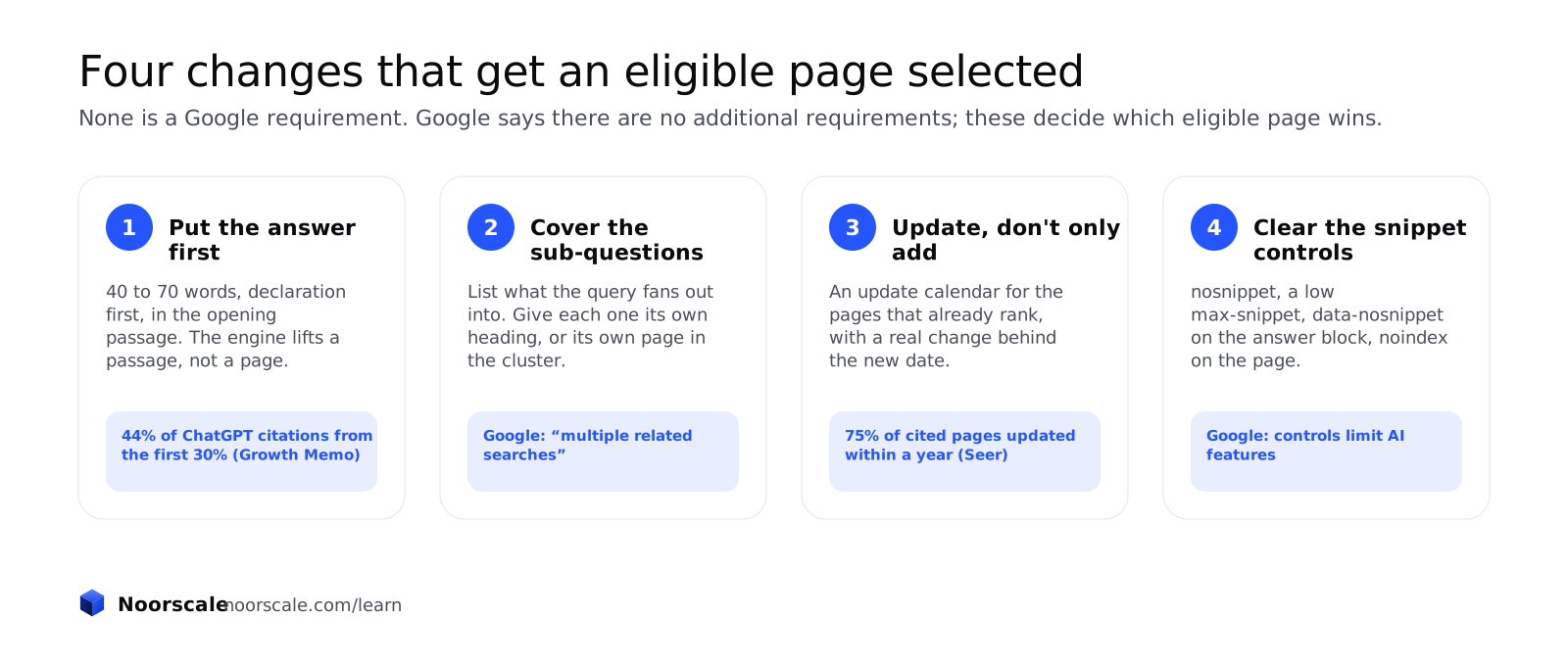
To appear in AI Overviews, a business should change four things on a page: put the answer in the first passage, cover the sub-questions query fan-out produces, update the page rather than only adding new ones, and remove snippet controls that limit what Google can show. None of the four is a new requirement from Google. They are the conditions under which an eligible page gets selected over another eligible page, which is a different and more useful thing to know. And none of them comes with a date attached. Anyone promising real results in 30 days is guessing. The first change is the smallest and the one most often skipped.
Should the answer come first on the page?
Yes, the answer should come first on the page, because AI features lift a passage rather than a page, and the passage that survives selection is the one that answers the sub-question in a single, self-contained block. The shape is specific: 40 to 70 words, declaration first, present tense, no setup, with the thing being defined named in the first sentence. The supporting evidence comes from ChatGPT rather than Google, so take it as a pattern and not a rule: 44% of ChatGPT citations come from the first 30% of a page (Growth Memo via Search Engine Land, 18,012 citations, 2026). No equivalent AI Overview figure has been published. But read your own best page and ask where the answer is. If it's in paragraph four, you've found your first edit. A first answer only wins the sub-question it answers, though; the rest need covering.
How do you cover the sub-questions that query fan-out produces?
You cover the sub-questions that query fan-out produces by listing the related questions a buyer asks around the head term, answering each one under its own heading on the page or on a linked page in the same cluster, and keeping each answer specific enough to be cited on its own. Query fan-out, to restate it, is Google issuing multiple related searches for one query; your job is to be the best answer to several of them. Google's "Succeeding in AI search" (May 2025) says AI features suit longer, more specific follow-up questions, and Ahrefs (March 2026) says fan-out "may now play a larger role" in which pages are cited, so this is where the ground has shifted most.
The work runs in four steps, and the first one is mostly listening.
- Find the sub-questions: People Also Ask, the questions an AI Overview already cites for your term, and the questions your sales team hears on calls.
- Group them: some belong on the page you have, some deserve a page of their own.
- Give each one a heading or a page, with the answer in its first sentence.
- Link them to each other, so the cluster reads as one source.
Coverage decays, which is why freshness is the next change.
How much does freshness matter for AI Overview citations?
Freshness matters a great deal for AI Overview citations: 75% of pages cited across AI engines were updated within the last year, and 78% of Gemini's cited pages were (Seer Interactive recency study, 47K citations, 2026). The practical rule is an update calendar for the pages that already rank, with a visible updated date and a dateModified value in the page's data that matches the change. This beats publishing a new page on the same topic, which splits your signals and starts the clock from zero. One honest caveat: a date change without a content change is not an update. Google reads the content, and so do the people who land on it. Change the figures that aged, answer the question that came up since, and then move the date. The last change is a technical one, and when it's wrong it blocks the other three.
Do snippet controls affect AI Overviews and AI Mode?
Yes, snippet controls affect AI Overviews and AI Mode: Google states that restrictive preview controls such as nosnippet and max-snippet limit how content is featured in AI features, because both features show content under the same snippet eligibility rules as Search. Many sites set these years ago for a reason that made sense at the time, so this isn't a scolding, just a check.
Four controls are worth checking on any page you want cited.
- nosnippet, which removes the page from snippet eligibility entirely.
- max-snippet with a low value, which caps how much text Google can show.
- data-nosnippet on the block that holds the answer.
- noindex on the page, which removes it from the index and from every AI feature with it.
One more thing to clear up while you're in the page's head: llms.txt does nothing for Google, because Google says it ignores it. Once the page is changed, the question is how to see whether it worked.
How do you measure whether you appear in AI Overviews and AI Mode?
You measure whether you appear in AI Overviews and AI Mode with the Search Console "Search Generative AI" report for impressions, a fixed set of tracked queries checked by hand or by a tool for citations, and GA4 landing-page data for the clicks, because no single report shows all three. The report launched on 3 June 2026 and it is useful, with two limits you should know before you open it.
| What you want to know | Where it shows | What it cannot show |
|---|---|---|
| Impressions | Search Console, Search Generative AI report (launched 3 June 2026) | Clicks. It also combines AI Overviews and AI Mode, with no split between the two. |
| Citations | A tracked query set, checked by hand or with a monitoring tool | There is no official report for citations. |
| Clicks | GA4 landing pages | AI Overview clicks arrive as google / organic and cannot be separated from ordinary search clicks. |
The tracked query set is the part most teams skip and the part that tells you most: twenty of your buyers' questions, checked on the same day each month, with the cited pages written down. How to measure AI Overview, AI Mode and ChatGPT traffic covers the GA4 setup and the query method in full. What the work costs and how long it takes before the report changes is next.
How much does appearing in AI Overviews cost, and how long does it take?
Appearing in AI Overviews costs the same as the SEO and AI search work it depends on, because the four changes above are done inside that work rather than sold separately. Agencies price it as a monthly retainer scoped to the number of pages, the competition and how much third-party work is needed, with the AI search part often added to an existing SEO program rather than bought on its own, and an audit priced as a one-off where the starting position isn't clear.
| Work | Pricing model | What it covers |
|---|---|---|
| SEO and AI search audit | One-off, fixed from a written scope | Indexing, snippet controls, which pages rank and which are cited, and the sub-question gaps |
| AEO and GEO as an add-on | Monthly, scoped by pages and tracked queries | Answer-first rewrites, sub-question coverage, the update calendar and monthly measurement |
| Full SEO retainer | Monthly, scoped by pages and competition | Everything above plus the pages themselves, where they don't exist yet |
On timing, Noorscale's working expectation, not a measured result, is that page changes on an already-ranking page show in AI citations in 4 to 8 weeks, and that rankings for new terms take 3 to 6 months. No agency can promise a citation or a date. If you're deciding between the three disciplines, GEO vs SEO vs AEO: what changes in AI search carries the full comparison and the decision by starting position.
How does Noorscale get pages into AI Overviews and AI Mode?
Noorscale gets pages into AI Overviews and AI Mode by building a semantic topical map that covers the sub-questions query fan-out produces, rewriting each page to open with a self-contained answer, running an update calendar for the pages that already rank, and checking snippet controls and indexing before any content work starts. The method comes from the founder's training in semantic SEO (a Semantic SEO Expert Certificate recognized by Koray Tuğberk GÜBÜR, March 2024), applied to how Google's AI features now retrieve pages. AI search optimization is where that program is scoped. What gets measured each month is the Search Generative AI impressions, a tracked query set, and GA4 landing pages, and results are reported as citations and impressions, not promised. Noorscale has no published AI Overview result for a client yet, and this page won't pretend otherwise.
What should you do this week?
This week, do one thing: search your three most important buying questions in Google, and for each one note whether an AI Overview appears, whether you're cited in it, and who is. Then open the top cited page and read its first paragraph next to yours. That comparison takes half an hour, and it will tell you more about what to change than any audit you could buy.

Comments
Disagree with something, or have a case this page doesn't cover? Noor reads every comment and replies to the ones that add something, here on the page. Your email is never shown.