AI search
How ChatGPT Chooses Sources and How to Get Cited
ChatGPT chooses sources by running a web search through its search crawler, OAI-SearchBot, and search providers that include Bing, reading the pages that come back, and citing the passages the answer was drawn from. A business gets cited by ChatGPT by being crawlable and indexed in Bing, answering first on the page, staying updated, and being listed where ChatGPT already looks.
- For
- Founders
- Marketing directors
- Anyone a competitor beat to a ChatGPT answer
 By Noor KhanFounder & CEO, Noorscale
- Published
- Published 8 November 2026
- Updated
- Updated 8 November 2026
- Reading time
- 17 min read
What is ChatGPT search and when does ChatGPT search the web?
ChatGPT search is the feature in ChatGPT that runs a live web search, reads the pages it retrieves and cites them in the answer, and ChatGPT uses it on about a third of queries: 34.5% in Semrush's February 2026 sample. There are two kinds of ChatGPT answer, and only one of them can mention your page. The first comes from the model's training data, with no search and no citations; it's what the model remembers, and it can be out of date or simply wrong about you. The second comes with search, and sources appear as linked citations beside the text. A person can also switch search on for a prompt. OpenAI publishes which crawler surfaces pages for ChatGPT search (OpenAI, bot documentation), but it doesn't publish the rule that decides when a prompt triggers a search, so the first thing to know is that it doesn't always happen.
Does ChatGPT search the web for every question?
No, ChatGPT does not search the web for every question; Semrush measured a web search on 34.5% of queries in February 2026, so roughly two in three answers come from the model alone and carry no citation. The practical consequence is that a page can only be cited on the prompts that trigger a search, which is why ChatGPT citation studies count "responses with a citation" rather than all responses. OpenAI hasn't published which prompts trigger one. What the studies cited on this page observe is that prompts asking for current, specific or comparative information tend to; a question about which provider to choose this year is far more likely to send ChatGPT to the web than a question about what a term means. So when you test your own brand later on this page, you'll turn search on deliberately. First, the crawler that does the surfacing.
Which OpenAI crawler decides what ChatGPT can cite?
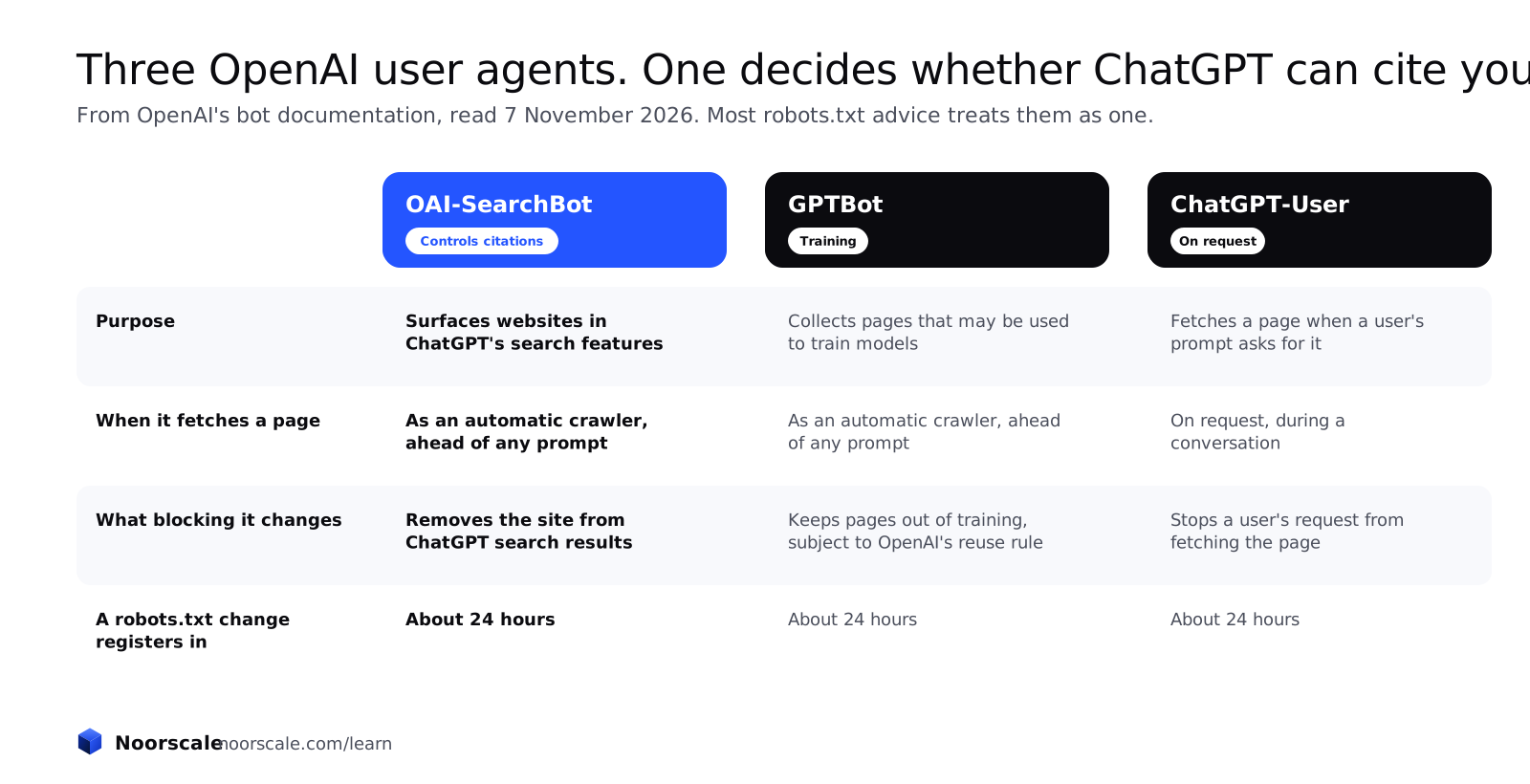
OAI-SearchBot decides what ChatGPT can cite: OpenAI's bot documentation says it "is used to surface websites in search results in ChatGPT's search features", while GPTBot is the training crawler and ChatGPT-User fetches a page only when a user asks for it. A crawler is an automated fetcher of pages, and a user agent is the name it identifies itself with in robots.txt and in your server logs. Three OpenAI user agents visit sites, and most robots.txt advice online treats them as one. They aren't, and the table below is the distinction this page exists to make.
| OAI-SearchBot | GPTBot | ChatGPT-User | |
|---|---|---|---|
| Purpose | Surfaces websites in ChatGPT's search features | Collects pages that may be used to train models | Fetches a page when a user's prompt asks for it |
| When it fetches a page | As an automatic crawler, ahead of any prompt | As an automatic crawler, ahead of any prompt | On request, during a conversation |
| What blocking it changes | Removes the site from ChatGPT search results | Keeps pages out of training, subject to OpenAI's reuse rule | Stops a user's request from fetching the page |
| A robots.txt change registers in | About 24 hours | About 24 hours | About 24 hours |
OpenAI says robots.txt changes take about 24 hours to register, so a fix made today is live tomorrow. What blocking the training crawler does and does not do deserves its own answer, because it's the most common mistake.
Does blocking GPTBot stop ChatGPT from citing a site?
No, blocking GPTBot does not on its own stop ChatGPT from citing a site, because ChatGPT search surfaces pages through OAI-SearchBot; blocking OAI-SearchBot does remove a site from ChatGPT search results. One caveat comes from OpenAI's own documentation: OpenAI may reuse one crawl for both purposes, so a site that allows OAI-SearchBot and blocks GPTBot should expect its pages to be fetched once, and should read OpenAI's current wording before relying on the split.
A robots.txt file can take one of three positions on OpenAI's crawlers, and each has a different result.
- Allow both: cited in ChatGPT search, and pages may be used for training.
- Allow OAI-SearchBot and block GPTBot: cited; training use depends on OpenAI's reuse rule.
- Block both: not cited.
Whichever you choose registers in about 24 hours. Where the search results themselves come from is next.
How does ChatGPT use Bing to find sources?
ChatGPT uses Bing as one of its search providers: Microsoft made Bing the default provider for ChatGPT browsing in May 2023, and OpenAI's VP of Engineering said in a November 2024 Reddit AMA that "we use a set of services and Bing is an important one". The evidence that this matters comes from Seer Interactive, which reported that 87% of SearchGPT citations matched Bing's top results in its 2024 to 2025 sample. Read that as a reported figure from one sample, not a law; OpenAI has since said it uses a set of services, and the number may well have moved. The practical reading hasn't: a page that Bing does not index has little route into a ChatGPT citation. If you've spent years thinking of Bing as the search engine nobody uses, this is the moment to open Bing Webmaster Tools. It's free, it takes an afternoon, and it's the part of ChatGPT work most sites skip. What happens after the search returns results is next.
How does ChatGPT select which sources to cite, and how many?
ChatGPT selects sources by sending one or more searches to its providers, fetching the pages that come back, keeping the passages the model used to write the answer, and citing those pages, which comes to about 15 sources per answer (Semrush 2026 AI Visibility Index, 126M prompts). OpenAI publishes no ranking function for this step; everything after retrieval is inferred from citation studies, and anyone who tells you otherwise is guessing.
The steps, as far as they can be observed from the outside, run like this.
- A search is issued to the providers for the prompt, or for several sub-questions behind it.
- Results are retrieved: the pages the providers return.
- Pages are fetched by OAI-SearchBot and read.
- Passages are selected: the parts the model uses to write the answer.
- Citations are attached to the pages those passages came from.
Fifteen sources per answer is more than Google's AI features cite, which means more room on the list, and also more competition for the eye. Which part of a page the passage tends to come from has a surprisingly precise answer.
Which parts of a page does ChatGPT cite?
ChatGPT cites the top of a page most: 44.2% of citations come from the first 30% of a page (Growth Memo via Search Engine Land, 18,012 ChatGPT citations, 2026). The same study found that cited pages read at a Flesch-Kincaid grade of 16 against 19.1 for pages that were not cited. Both are above a general audience's reading level, so the honest reading is "cited pages are clearer than their competitors", not "write simply". That finding is why this page, and every guide here, puts the direct answer, the key takeaways and the main visual in the first 30%: it's the part that gets read, by machines and people alike. Which domains receive those citations is next.
Which domains and page types does ChatGPT cite most?
ChatGPT cites Wikipedia most of all, at 7.8% of about 680 million citations between August 2024 and June 2025 (Profound), followed by Reddit at 1.8%, Forbes at 1.1% and G2 at 1.1%, and .com domains take 80.41% of its citations. Before you despair at competing with Wikipedia, notice how flat the list is below the top entry. The long tail of ordinary sites holds most of the citations, and that tail is where a specific page about a specific question lives.
| Domain | Share of citations | Source and period |
|---|---|---|
| Wikipedia | 7.8% | Profound, about 680M citations, August 2024 to June 2025 |
| 1.8% | Profound, same period | |
| Forbes | 1.1% | Profound, same period |
| G2 | 1.1% | Profound, same period |
| All .com domains | 80.41% | Profound, same period |
Page types tell a different story from domains. Surfer's September 2026 analysis of ChatGPT's top 50 cited domains put clutch.co second and g2.com third, with review and directory sites at 23.6% of top-50 citations. And here is a conflict to weigh rather than hide: a DerivateX study of B2B SaaS prompts found G2 and Capterra at zero citations in its sample. The difference is scope, all-category top-50 domains against one vertical's prompts, and the lesson is to test your own category with the prompt panel further down rather than assume either figure. The Profound numbers also predate a shift, which the chart above shows.
Why did Reddit and Wikipedia citations fall in ChatGPT in 2025?
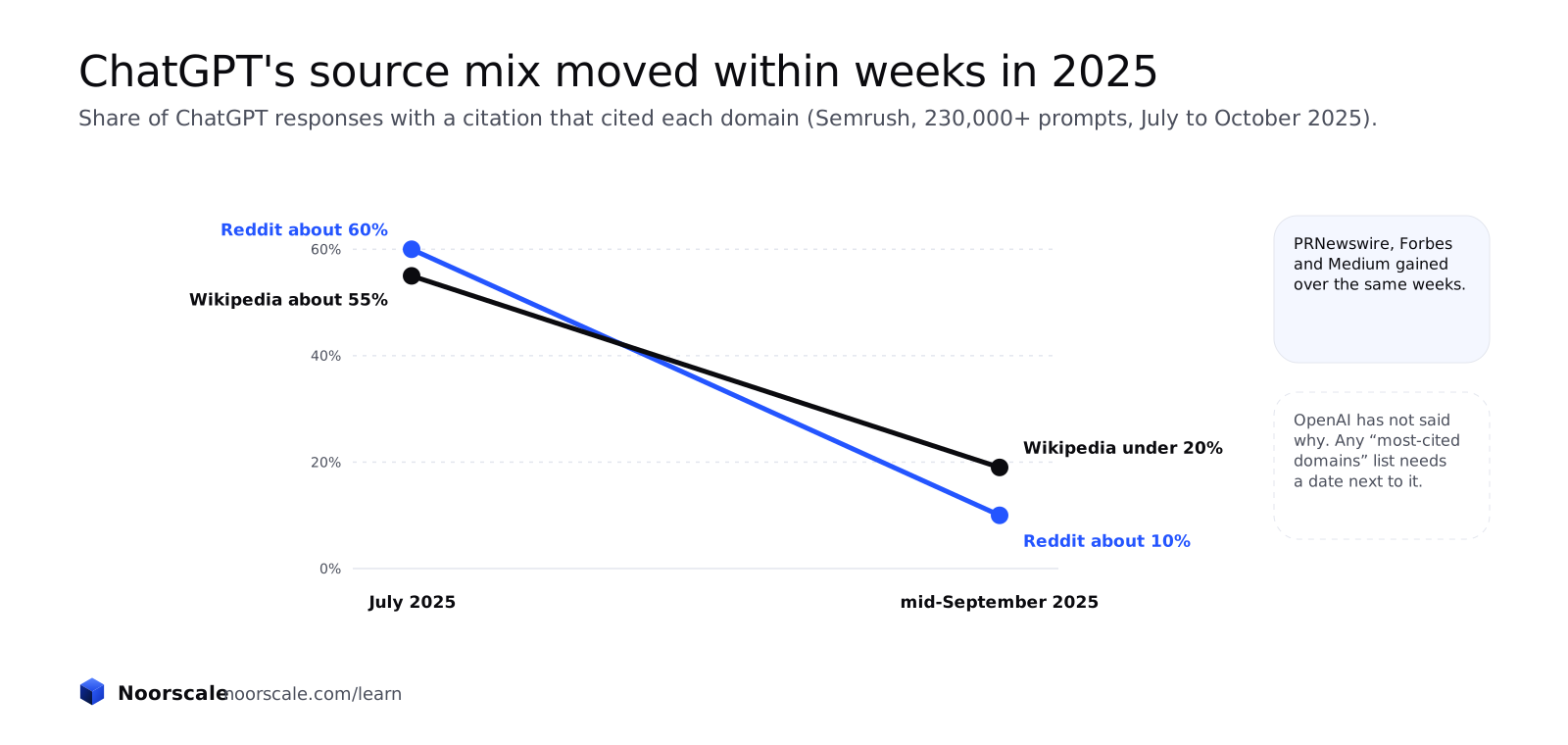
Reddit and Wikipedia citations fell in ChatGPT during the second half of 2025, and OpenAI has not said why: Semrush (230,000+ prompts, July to October 2025) measured Reddit falling from about 60% to about 10% of ChatGPT responses with a citation, and Wikipedia from about 55% to under 20%, by mid-September 2025, while PRNewswire, Forbes and Medium gained. Two measurements that look like they contradict each other don't. Profound's 7.8% is Wikipedia's share of all citations across eleven months; Semrush's 55% is the share of responses that cited Wikipedia at all. Different units, both true; the direction of Semrush's series is the point. Ahrefs added another series in November 2026: OpenAI's partner publishers were 7.5% of ChatGPT's top-200 citations in March 2026, 15.8% in July and 12.5% in late September. The source mix moves within months. That's why any "most-cited domains" list needs a date next to it, and why your own panel beats a published list. Two page attributes hold up across all of these shifts.
Does ChatGPT favor original research and recently updated pages?
Yes, ChatGPT favors original research and recently updated pages: Growth Memo's research index finds that primary research is rare but far more citation-dense than ordinary pages when it appears, and 73% of ChatGPT-cited pages were updated within the last year (Seer Interactive, 47K citations, 2026). Ahrefs adds the URL-age finding: AI-cited URLs average 1,064 days old against 1,432 for organic results, so cited pages are both younger as URLs and more recently updated. Seer's reading, in paraphrase, is that the freshness being rewarded comes from updating, not only from publishing new pages. And "original research" is within reach of a company of any size: a survey of your own customers, your own aggregated data, or a test you ran, with the method published alongside the result. The research doesn't need to be large. It needs to be yours, and dated. A citation is not the same as being named, though, and the next distinction is the one that confuses most dashboards.
What is the difference between a ChatGPT mention and a ChatGPT citation?
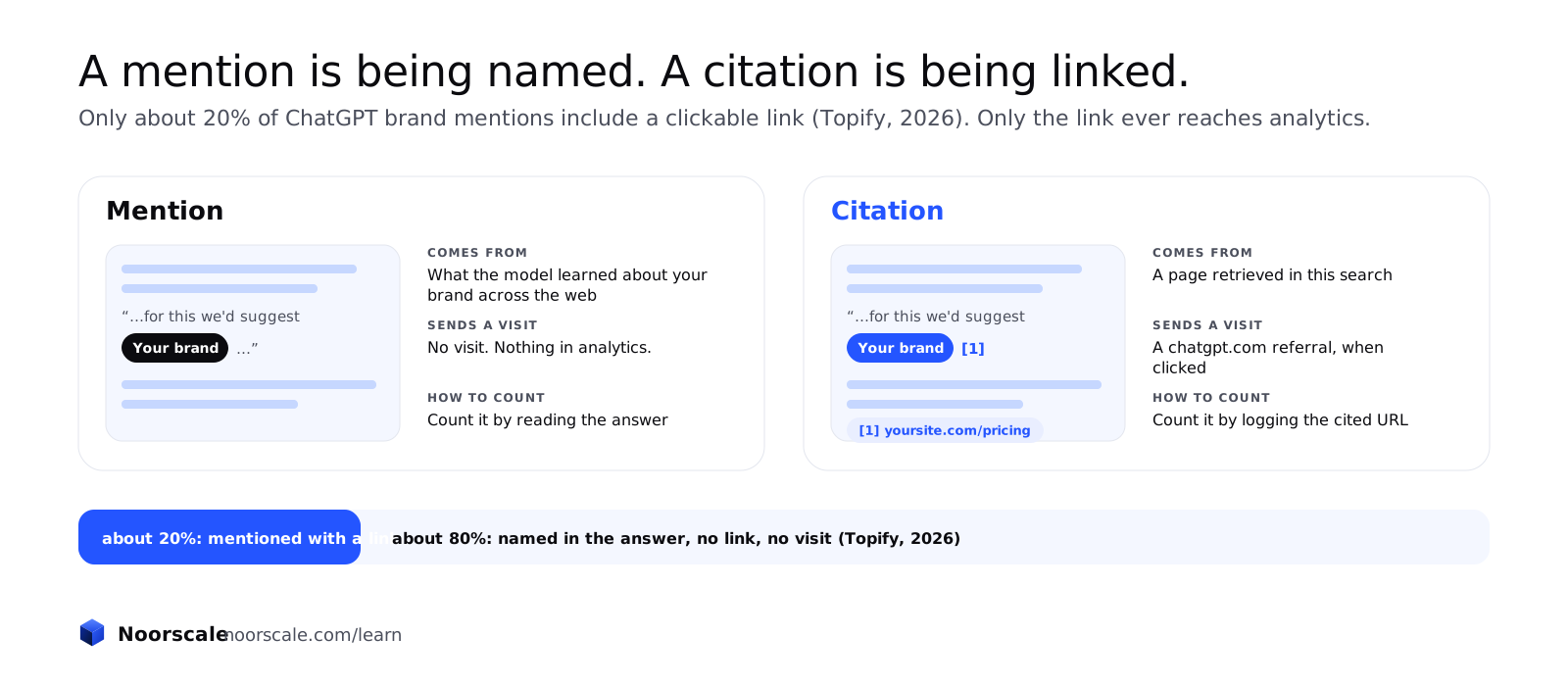
A ChatGPT mention is a brand's name appearing in the answer text, while a ChatGPT citation is a linked source the answer was drawn from, and only about 20% of ChatGPT brand mentions include a clickable link (Topify, 2026). If a client or a colleague has told you "ChatGPT recommends us" and your analytics show nothing from chatgpt.com, this is why. Both of them are right.
| Mention | Citation | |
|---|---|---|
| What it is | The brand's name in the answer text | A linked source shown with the answer |
| Where it comes from | What the model learned about the brand across the web, plus the pages it read for this answer | A page retrieved in this search |
| Sends a visit? | No | Yes, as a chatgpt.com referral, when someone clicks |
| How it is counted | By reading the answer, by hand or with a tool | By logging the cited URL |
A brand can have many mentions and no citations. It shows up as ChatGPT recommending you while no visit ever arrives, which is a good problem and a confusing one. Only the citation produces the chatgpt.com referral that analytics can see; the mention has to be counted another way, and the prompt panel further down does that. How to measure AI Overview, AI Mode and ChatGPT traffic covers the referral side. How much of all this tracks Google is next.
How much do ChatGPT citations overlap with Google rankings?
ChatGPT citations overlap with Google rankings far less than with Bing results: only about 12% of ChatGPT, Gemini and Copilot citations ranked in the Google top 10 (Ahrefs, 15,000 prompts, August 2025), while Seer Interactive reported 87% of SearchGPT citations matching Bing's top results. Note that the Ahrefs figure pools three engines, so it is a ceiling for ChatGPT alone rather than an exact share.
| Surface | Overlap | Source |
|---|---|---|
| ChatGPT (pooled with Gemini and Copilot) against the Google top 10 | About 12% | Ahrefs, 15,000 prompts, August 2025 |
| SearchGPT against Bing's top results | 87% | Seer Interactive, 2024 to 2025, reported |
| Google AI Overviews against the Google top 10, for contrast | 38% by March 2026 | Ahrefs, 863K keywords |
Ranking in Google is not the route into ChatGPT; being indexed and ranked in Bing, and being the kind of page the model fetches, is. Google's own engines select from the Google index with query fan-out, and how Google AI Overviews and AI Mode choose their sources holds that mechanism in full. From here on, this page is about what to change.
What should a business change to get cited by ChatGPT?
To get cited by ChatGPT, a business changes seven things: it allows OAI-SearchBot, gets indexed in Bing, opens every page with the answer, serves server-rendered HTML, updates pages instead of only adding them, lists on the directories ChatGPT already cites, and publishes original research. Three of the seven raise the most questions and get their own sections below. The other four close here, with the evidence already on this page and a note on whose job each one is, because half of these are a developer's afternoon and the other half are a writer's month.
| Change | Why it matters | Evidence on this page | Who does it |
|---|---|---|---|
| Allow OAI-SearchBot | It's the crawler OpenAI names for ChatGPT search | OpenAI bot documentation | Developer |
| Get indexed in Bing | Bing is the provider OpenAI calls "an important one" | 87% Bing overlap (Seer Interactive, reported) | Developer or owner |
| Open with the answer | Citations come from the top of the page | 44.2% from the first 30% (Growth Memo) | Writer |
| Serve server-rendered HTML | No major AI crawler renders JavaScript | Vercel and MERJ | Developer |
| Update, don't only add | Cited pages are recently updated | 73% within a year (Seer Interactive) | Writer |
| List on cited directories | Clutch and G2 were 2nd and 3rd most-cited in the top 50 | Surfer, September 2026 | Owner |
| Publish original research | Primary research is citation-dense when it appears | Growth Memo, qualitative | Owner and writer |
The first two changes are the gate, so they come first.
Should you allow OAI-SearchBot and get indexed in Bing?
Yes, allow OAI-SearchBot and get indexed in Bing, because OAI-SearchBot is the crawler OpenAI names for ChatGPT search and Bing is the search provider OpenAI calls "an important one".
The check takes an afternoon and runs in five steps.
- Read robots.txt for a Disallow that covers OAI-SearchBot, or a wildcard rule that catches it.
- Check CDN and firewall rules that block bots by category. These can block OAI-SearchBot without a single line in robots.txt, and they're the usual culprit when robots.txt looks fine.
- Allow about 24 hours after any change (OpenAI).
- Verify the site in Bing Webmaster Tools, submit the sitemap, and check that your key pages are indexed.
- Run a prompt with search on, and look for your domain.
Whether the page can be read once it is fetched is the next question.
Should you serve server-rendered HTML for ChatGPT?
Yes, serve server-rendered HTML, because no major AI crawler renders JavaScript (Vercel and MERJ), so content that appears only after a script runs is invisible to OAI-SearchBot. The check is simple and most people have never done it: view the page source, not the rendered page in your browser's inspector, and confirm the answer paragraph, the headings and the tables are in it. Prices, reviews and specifications loaded by script are the common gaps; the page looks complete to a person and empty to a crawler. Two sentences on llms.txt, since it comes up: Ahrefs found 97% of llms.txt files are never read by any crawler, and Google says it ignores the file. It is not a substitute for crawlable HTML, and this page doesn't recommend relying on it. The off-site question is next.
Do directory listings such as Clutch and G2 help with ChatGPT citations?
Yes, directory listings on sites such as Clutch and G2 help with ChatGPT citations in most categories, because clutch.co and g2.com were the second and third most-cited domains in ChatGPT's top 50 (Surfer, September 2026) and review and directory sites took 23.6% of those citations, with one conflicting study to weigh. That study, from DerivateX, found G2 and Capterra at zero citations in its B2B SaaS sample. So run your category's own prompts before paying for a listing, and treat a directory profile as a mention source first and a citation source second. For a listing to be useful, it needs a complete profile, the same name and description as your site, and reviews with dates. Services businesses tend to find Clutch is the one that matters; software companies, G2 and Capterra. How to know whether any of it worked is next.
How do you check whether ChatGPT cites your brand?
You check whether ChatGPT cites your brand by running a fixed panel of buyer prompts in ChatGPT with search on, recording every mention and every cited URL, and repeating the same panel on a schedule.
The manual version costs nothing but an afternoon a month, and it teaches you what to track before you pay a tool to track it.
- Write 20 to 50 prompts your buyers would type: comparisons, "best" questions, "how to choose" questions, and the problem your service solves.
- Run each in a new chat with search on.
- Log four things per prompt: mention yes or no, citation yes or no, the cited URL, and where in the answer it appeared.
- Rerun monthly on the same prompts, with the same wording.
- Expect variation between runs, and count a trend, not a single answer.
Keep the mention and citation columns separate; the 20% figure above is the reason. AI visibility monitoring tools such as Profound, Peec, Otterly and the Semrush AI toolkit automate the same panel, and they earn their place once the manual version has shown you what matters in your category. What the work costs is next.
How much does getting cited by ChatGPT cost, and how long does it take?
Getting cited by ChatGPT costs the same as other AI search work at an agency, because it shares the pages, the updates and the mentions with SEO; the ChatGPT-specific parts are crawler access, Bing indexing and the prompt panel. Agencies price it as a monthly retainer or an add-on to one, with the access checks done inside a one-off audit.
| Work | Pricing model | Time to a visible result |
|---|---|---|
| Crawler and Bing access | Part of an SEO and AI search audit, priced one-off from a written scope | A robots.txt change registers with OpenAI in about 24 hours; Bing indexing follows once the sitemap is in |
| Answer-first rewrites and updates | Monthly, as an add-on to an SEO retainer or inside one | Structure changes have been reported to show in AI citations in 4 to 8 weeks (several 2026 sources) |
| Directory profiles and original research | Monthly, scoped by how many listings and studies | Months, because other sites have to pick them up first |
No agency can promise a citation, and a flat result on the panel is still a result. How Noorscale runs it is next.
How does Noorscale get clients cited by ChatGPT?
Noorscale gets clients cited by ChatGPT with the same program it runs for Google: crawler and Bing access first, answer-first pages on a semantic topical map, directory and third-party mentions, and a monthly prompt panel that records mentions and citations separately. The method comes from the founder's training in semantic SEO (a Semantic SEO Expert Certificate recognized by Koray Tuğberk GÜBÜR, March 2024). AI search optimization is where the program is scoped and where you can see what a month of it contains. Noorscale's published client results are search results, not ChatGPT figures, so none is quoted here; when there is a ChatGPT result with a control behind it, it will be on this page with its date.
What should you do this week?
This week, do two things that cost nothing. Open your robots.txt and look for OAI-SearchBot, by name or under a wildcard. Then open ChatGPT, switch search on, type the question your best customer asked before they found you, and write down who is cited and who is merely named. If you're in neither column, you now know which of the seven changes comes first.

Comments
Disagree with something, or have a case this page doesn't cover? Noor reads every comment and replies to the ones that add something, here on the page. Your email is never shown.