AI search
Does Generative Engine Optimization Work? The Evidence So Far
Generative engine optimization works in the narrow sense that a page already retrieved by an AI engine can be rewritten to be cited more often, and it is unproven in the broad sense that GEO tactics get a page retrieved, clicked or paid for in the first place. The tactics with evidence behind them are the ones search has always rewarded; the tactics without are the ones most often sold as new.
- For
- Founders
- Marketing directors
- Anyone being pitched GEO
 By Noor KhanFounder & CEO, Noorscale
- Published
- Published 8 November 2026
- Updated
- Updated 8 November 2026
- Reading time
- 21 min read
What would it mean for generative engine optimization to work?
For generative engine optimization to work, a change made to a page or a brand's presence would have to raise one of four measures that the business did not already get from SEO: citations in AI answers, brand mentions in AI answers, visits from AI engines, or revenue from those visits. Generative engine optimization is the practice of making a brand's pages, data and mentions the sources that large language model answers cite and recommend. "Works" means a measurable lift against a control, not a before-and-after on one page. Before anyone sells you the practice, it's worth knowing that Google itself says there are "no additional requirements to appear in AI Overviews or AI Mode" and "no special schema.org structured data" (Google Search Central, AI features and your website). And it's worth knowing why the claim level matters: Ahrefs quoted Wil Reynolds on a page whose ChatGPT citations rose 1,900% month on month "with little business impact" (July 2026). A number went up. Nothing else did.
| Claim level | What counts as evidence | Who has published it | How strong it is |
|---|---|---|---|
| Citations in AI answers | A controlled lift in citation rate against untouched pages | Every study in the table below measures this | Mixed: positive when a page is already retrieved, flat or negative otherwise |
| Brand mentions in AI answers | Correlation with mentions on other sites, or a tracked prompt panel | Ahrefs (75,000 brands); the Search Engine Land experiments | Correlational, consistent in direction |
| Visits from AI engines | Referral sessions from chatgpt.com, perplexity.ai and the rest, tied to a change | Almost nobody, in a controlled form | Thin |
| Revenue from those visits | Attributed revenue from AI referrals against a control | No published controlled result found in this research | None found |
The citation level is the one most studies measure, so the first honest question is whether a citation is worth anything on its own.
Is being cited by an AI engine the same as getting traffic from it?
No, being cited by an AI engine is not the same as getting traffic from it, because most AI answers are read without a click and the citation is the only trace a brand gets. Ahrefs estimates AI Overviews cut clicks by about 58%, with the click-through rate for position one falling from 0.037 to 0.016 (Ahrefs, AI search trends, July 2026). Google's Search Console AI performance report shows impressions only, and AI Overview clicks arrive as google / organic in GA4, so they can't be separated. ChatGPT and Perplexity referrals do appear, as chatgpt.com and perplexity.ai. So a citation is a leading indicator and nothing more. It says the engine trusted the page enough to name it; it does not say anyone came. With the claim defined, the paper that started the term is the first piece of evidence.
What did the original GEO paper test and find?
The original GEO paper, "GEO: Generative Engine Optimization" by Pranjal Aggarwal, Vishvak Murahari, Tanmay Rajpurohit, Ashwin Kalyan, Karthik Narasimhan and Ameet Deshpande (Princeton, Georgia Tech, the Allen Institute for AI and IIT Delhi, first posted November 2023, published at KDD 2024), tested nine ways of rewriting a page and found that adding quotations, statistics and source citations raised the page's share of a generated answer by roughly 30 to 40% on its own metric. The benchmark was GEO-bench, 10,000 queries. The engine was a two-step setup that fetched the top five Google results and generated the answer with gpt-3.5-turbo. The two metrics were "Position-Adjusted Word Count" and "Subjective Impression".
The paper tested nine rewriting methods, under its own names for them.
- Cite Sources
- Quotation Addition
- Statistics Addition
- Authoritative
- Fluency Optimization
- Easy-to-Understand
- Unique Words
- Technical Terms
- Keyword Stuffing
The reported bests were 41% on word count and 28% on impression. The top three methods ran 30 to 40% on word count and 15 to 30% on impression. Keyword Stuffing showed "little to no improvement" and scored below the untouched baseline on word count. A 200-query check on Perplexity found Quotation Addition about 22% better on word count and Keyword Stuffing about 10% worse than baseline. The result is real inside the paper's setup. The next section explains why that setup is not a live engine.
Why do the paper's gains not transfer to a live engine?
The paper's gains do not transfer to a live engine because every tested page was already among the five sources handed to the model, so the experiment measured how much of an answer a retrieved page could claim, not whether a page gets retrieved at all. That distinction is the whole argument of this page, and two later papers make it precisely. Olivier Martinez's "Optimizing Visibility in Generative Engines: A Critical Survey of Generative Engine Optimization (2023-2026)" (arXiv, July 2026) concludes that "no reviewed technique shows a stable, longitudinal, cross-platform causal effect on organic discoverability", with the narrower positive that "already-retrieved content can causally alter its citation or use". And a controlled two-document test of 252,000 trials across six models found that topical relevance and list position had the largest effect on which source was cited first, that price information and a recent timestamp helped, and that "formatting-only edits" had minimal impact (Rahul Vishwakarma, Shushant Kumar and Ratnesh Jamidar, "What Gets Cited: Competitive GEO in AI Answer Engines", arXiv, May 2026). One more thing: the paper's engine ran on gpt-3.5-turbo, a model no public engine uses in 2026. The tests that came after it are the ones a business should weigh.
What have later tests of GEO tactics found?
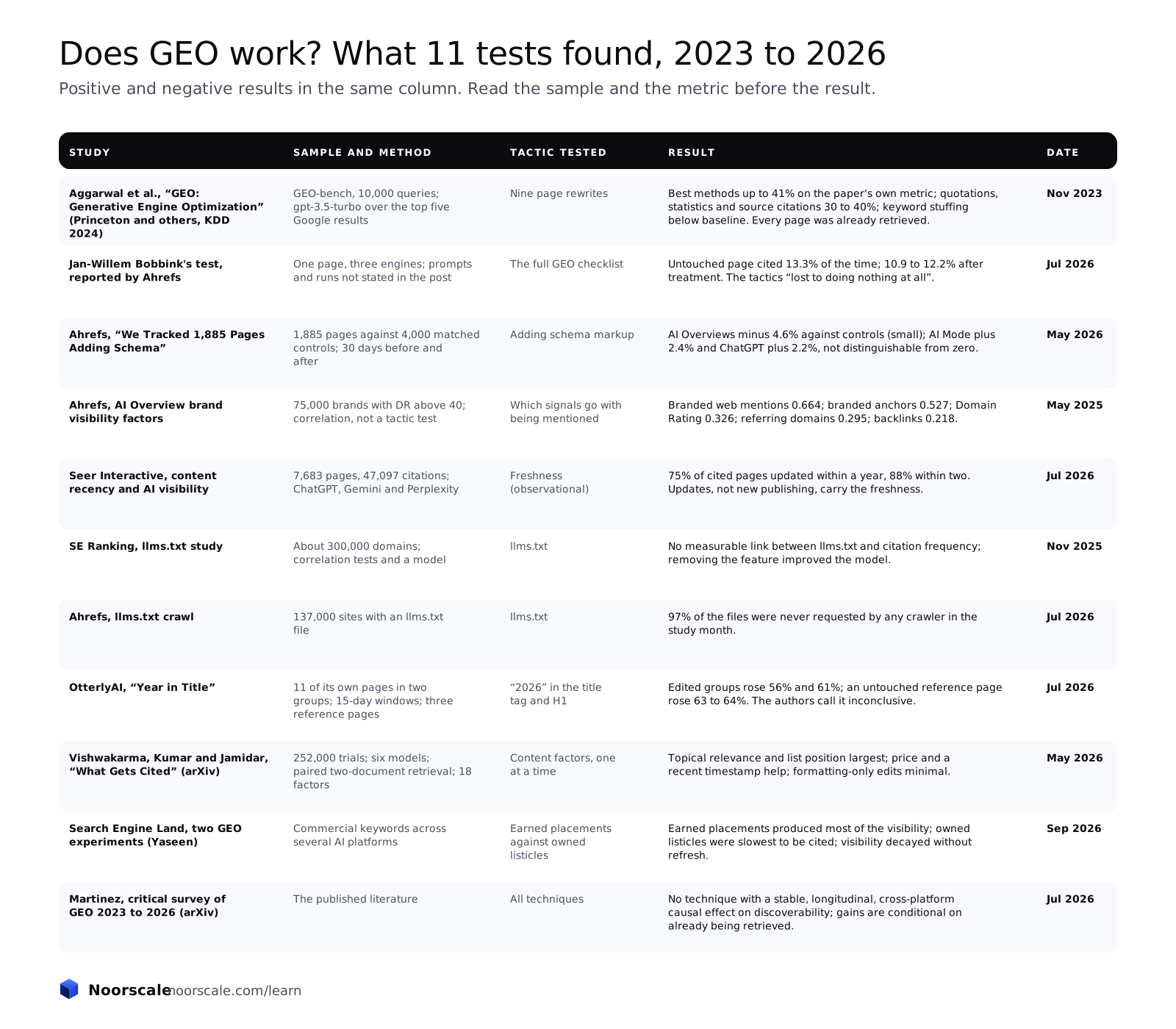
Later tests of GEO tactics have found small, mixed or negative effects: a full GEO treatment lost to an untouched page in a 2026 test reported by Ahrefs, adding schema to 1,885 cited pages produced no uplift, llms.txt showed no link to citations across about 300,000 domains, and the factors that did hold up were relevance, freshness, mentions on other sites and original data. Every test is below with its sample, because a result without a sample is a slogan.
| Study | Sample and method | Tactic tested | Result | Date |
|---|---|---|---|---|
| Aggarwal et al., GEO (KDD 2024) | GEO-bench, 10,000 queries; gpt-3.5-turbo over the top five Google results; 200-query Perplexity check | Nine page rewrites | Best methods up to 41% on Position-Adjusted Word Count and 28% on Subjective Impression; Quotation, Statistics and Cite Sources 30 to 40%; Keyword Stuffing below baseline | Nov 2023; published Aug 2024 |
| Jan-Willem Bobbink's test, reported in Ahrefs, "5 AI Search Trends I'm Seeing in 2026" (Louise Linehan) | One page across three engines; prompts and runs not stated in the post | The full GEO checklist: statistics, quotations, source citations, authoritative tone | Untouched page cited 13.3% of the time on GPT-4o-mini; 10.9 to 12.2% after treatment. In Bobbink's words, the tactics "lost to doing nothing at all" | 24 Jul 2026 |
| Ahrefs, "We Tracked 1,885 Pages Adding Schema. AI Citations Barely Moved." (Linehan, Guan) | 1,885 pages that added JSON-LD against 4,000 matched controls; 30 days before and after; difference-in-differences | Adding schema markup | AI Overviews minus 4.6% relative to controls (significant, small); AI Mode plus 2.4% and ChatGPT plus 2.2%, not distinguishable from zero | 11 May 2026 |
| Ahrefs, "An Analysis of AI Overview Brand Visibility Factors" (Linehan, Guan) | 75,000 brands with DR above 40; correlation, not a tactic test | Which signals go with being mentioned | Spearman correlation with AI Overview mentions: branded web mentions 0.664, branded anchors 0.527, branded search volume 0.392, Domain Rating 0.326, referring domains 0.295, backlinks 0.218 | 26 May 2025 |
| Seer Interactive, "Content Recency's Impact on AI Visibility in 2026" (Sonny Vasquez) | 7,683 dated pages carrying 47,097 citations from four brands; ChatGPT, Gemini and Perplexity; March to June 2026; observational | Freshness | 75% of cited pages updated within a year (Gemini 78%, ChatGPT 73%, Perplexity 65%), 88% within two; in a 4,124-page subset, 72% updated within a year but only 42% published within a year | 24 Jul 2026 |
| SE Ranking, llms.txt study (reported by Search Engine Journal) | About 300,000 domains; correlation tests and an XGBoost model | llms.txt | No measurable link between llms.txt and citation frequency; removing the feature improved the model | Nov 2025 |
| Ahrefs llms.txt crawl, in the AI search trends post | 137,000 sites with an llms.txt file | llms.txt | 97% of the files were never requested by any crawler in the study month | Jul 2026 |
| OtterlyAI, "Year in Title: Does It Increase AI Citations?" (Thaylise Nakamoto) | 11 of the vendor's own pages in two groups; 15-day windows; three untouched reference pages | Adding "2026" to the title tag and H1 | Edited groups rose 56% and 61%; an untouched reference page rose 63 to 64% in the same windows; 86% of the net gain came from one URL; the authors call it inconclusive | Jul 2026 |
| Vishwakarma, Kumar and Jamidar, "What Gets Cited" (arXiv) | 252,000 trials; six models; paired two-document retrieval; 18 factors changed one at a time | Content factors | Topical relevance and list position largest; explicit price and a recent timestamp help; completeness and trust cues smaller; formatting-only edits minimal | May 2026 |
| Search Engine Land, "Two GEO experiments challenge conventional AI visibility advice" (Zeeshan Yaseen) | Commercial keywords across several AI platforms; sample reported in secondary coverage | Earned third-party placements against owned listicles | Earned placements produced most of the visibility; owned listicles were the slowest to be cited and a small share of mentions; visibility decayed when placements were not refreshed | 14 Sep 2026 |
| Martinez, critical survey of GEO 2023 to 2026 (arXiv) | The published literature | All techniques | No technique with a stable, longitudinal, cross-platform causal effect on discoverability; gains are conditional on a source already being retrieved | 15 Jul 2026 |
Two things to take from the table. The only controlled results are the schema test and the paired-document test, and both say content and relevance beat markup. And everything positive that survives is also what SEO has always rewarded: a relevant page, kept current, that other sites mention. The table sorts into tactics with evidence and tactics without.
Which GEO tactics have evidence behind them?
The GEO tactics with evidence behind them are the ones that also work in search: answering the question first, covering the sub-questions an engine fans out to, earning mentions on sites the engines already cite, updating pages rather than only adding them, and publishing original data. If that list looks familiar, that's the point.
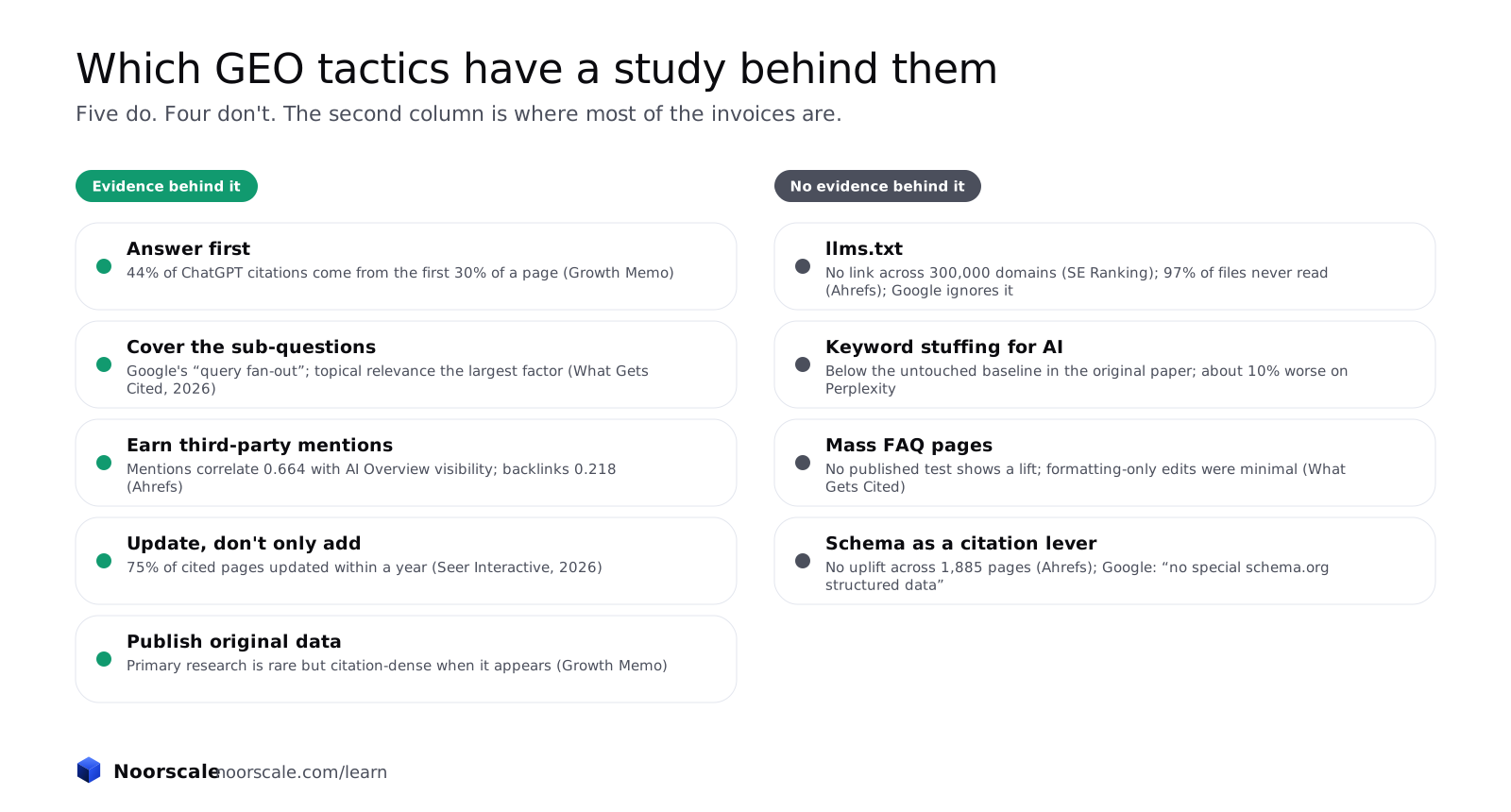
Each of the five carries at least one published result.
- Answer first. 44% of ChatGPT citations come from the first 30% of a page (Growth Memo via Search Engine Land, 18,012 citations, 2026), and the paper's own Quotation and Statistics results point the same way.
- Cover the sub-questions. Google's "query fan-out" wording describes several searches behind one query, and the paired-document test found topical relevance the largest factor.
- Earn mentions on other sites. Branded web mentions correlate 0.664 with AI Overview visibility against 0.218 for backlinks (Ahrefs), and the Search Engine Land experiments found earned placements produced most of the visibility.
- Update, don't only add. 75% of cited pages were updated within a year, and Seer's line is that "the freshness LLMs reward is being manufactured by updates, not by new publishing".
- Publish original data. Growth Memo's index finds primary research rare but citation-dense when it appears, and Seer observed that the research that earned press was agency-sized, with a method and a human angle.
The list of tactics without evidence is shorter and more expensive.
Which GEO tactics have no evidence behind them?
The GEO tactics with no evidence behind them are llms.txt, keyword stuffing aimed at AI engines, mass-produced FAQ pages, and schema markup used as a citation lever rather than as a description of what is on the page. None of these is harmful in itself. Each one is a place money goes that could have gone to the first list.
Each of the four has a negative or empty result against it.
- llms.txt. No link to citation frequency across about 300,000 domains (SE Ranking); 97% of 137,000 files never requested by any crawler (Ahrefs); and Google has said it ignores the file.
- Keyword stuffing for AI. Below the untouched baseline on word count in the original paper, and about 10% worse on Perplexity.
- Mass FAQ pages. No published test found that shows FAQ pages alone lift citations, and the paired-document test found formatting-only edits minimal.
- Schema as a lever. No uplift across 1,885 pages (Ahrefs), and Google says "no special schema.org structured data" is needed.
Schema still helps engines read entities and dates, which is a different job from earning a citation and a good reason to keep it accurate. A tactic can also fail in one engine and hold in another, and the next section says why.
Why do GEO results differ by engine?
GEO results differ by engine because each engine retrieves from a different index, weights rankings differently, and re-runs its retrieval on different schedules, so the same page can be cited by Perplexity, ignored by ChatGPT and dropped by AI Overviews in the same month. Google's "query fan-out" wording, several related searches behind one query, is the reason its own overlap with the top 10 fell.
| Engine | What it retrieves from | Overlap with the Google top 10 | What that means for a test |
|---|---|---|---|
| Google AI Overviews | Google's index, with query fan-out | 76.1% of citations in July 2025 (Ahrefs, 1.9M citations); 38% by March 2026 (Ahrefs, 863K keywords), with the rest split almost evenly between positions 11 to 100 (31.2%) and beyond (31.0%) | Rankings still help; sub-question coverage decides |
| Google AI Mode | Google's index, fanned out further | About half of domains and about a third of URLs; about seven domains per answer against three for AI Overviews (Semrush, 5,000 keywords, 150,000 citations, July 2025) | More room on the list, further down the results |
| ChatGPT | OAI-SearchBot and search providers that include Bing (OpenAI bot documentation) | Low; Bing's index is the one that matters | Test Bing indexing before anything else |
| Perplexity | Its own live search | Over 91% of domains and 82% of URLs (Semrush, same study) | Closest to Google; a ranking page is likely to be cited |
The full mechanism for Google's two features is on its own page: how Google AI Overviews and AI Mode choose their sources. The overlap figures also explain the case that worries most buyers: a page that ranks and still goes uncited.
Why can a page rank first in Google and still be absent from AI answers?
A page can rank first in Google and still be absent from AI answers because the engine answers the sub-questions behind the prompt rather than the prompt itself, prefers the passage that states the answer, and favors sources it has cited before, so a ranking page with a slow opening, no direct passage and no third-party mentions loses to a lower-ranked page that has them. The 38% figure says it in one number: by March 2026, most AI Overview citations came from outside the top 10. ChatGPT's most-cited domain is Wikipedia and Perplexity's is Reddit (Profound, 680M citations, 2025), neither of which ranks first for most commercial queries. And only about 12% of links cited by ChatGPT, Gemini and Copilot appear in Google's top 10 for the same prompt (Ahrefs, 2025).
When a first-ranked page goes uncited, the cause is usually one of three.
- The answer is buried. The page opens with context and gets to the point in paragraph four.
- The sub-question isn't covered. The page answers the head term and not the specific question the engine fanned out to.
- The brand isn't mentioned where the engine looks. No directory profile, no third-party page, no community thread names it.
The Bing, crawler and directory detail for ChatGPT lives in how ChatGPT chooses sources. With the evidence laid out, the business decision follows.
Is GEO worth it for a business in 2026?
Yes, GEO is worth it for a business in 2026 when its buyers already ask assistants for recommendations and its pages already rank, and no, it is not worth paying for as a separate program when the site has no rankings, no mentions and no way to measure a citation. The honest call depends on where you're starting from, and the table below says it without a sales pitch attached.
| Starting position | The honest call | What to buy instead, or first |
|---|---|---|
| No rankings to speak of | Not yet. There is nothing for an engine to retrieve. | The SEO foundation: technical health, one page per question, links and mentions |
| Rankings, but no citations | Yes, as an add-on to the SEO you already run | Answer-first rewrites, sub-question coverage, an update calendar, and a prompt panel to measure it |
| Cited in Google, absent in ChatGPT | Yes, with the work pointed at the right index | Bing indexing, crawler access, directory profiles and original research |
Two practitioner views are worth holding side by side, and both are honest. Peter Rota, Senior Technical SEO Manager at HUB International, put it this way on the Noorscale podcast: "If you have a basic foundation of SEO, you're going to get 80% of the way there." His own caveat from the same conversation is that the remaining 20% is work SEO rarely covers, such as how assistants describe the brand and pages like support docs; Peter Rota on the Noorscale podcast has the full exchange. The other view is the title of an r/SEO thread from April 2026: "Most 'GEO experts' are just SEO consultants who changed their LinkedIn bio". The search demand tells the same story from a different angle. Searches for "generative engine optimization" fell by roughly 45% in the year to September 2026 while "AI SEO" grew, by third-party estimates. The term is losing ground. The work is not. A business that is unsure should test rather than buy, and the test takes 60 days.
How do you run your own 60-day GEO test?
You run your own 60-day GEO test by fixing a panel of prompts, recording which pages each engine cites on two dates 60 days apart, changing a set of test pages in between, and leaving a matched set of control pages untouched. The model to copy, at small scale, is the Ahrefs schema test: matched controls, a window before and after, and a comparison of the difference rather than the raw change. Bobbink's test is the reminder of why: a full checklist can lose to nothing.
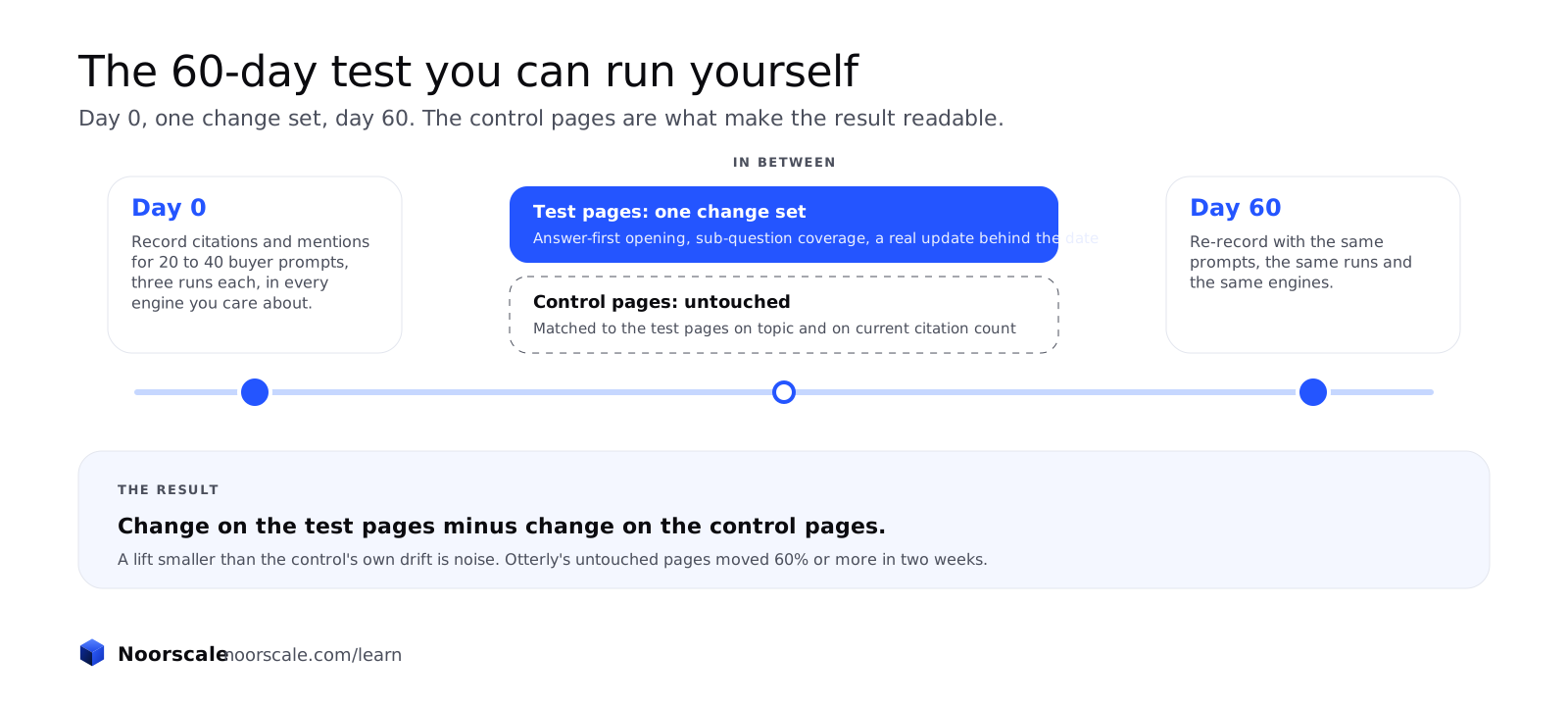
The test runs in six steps, and the last one is the one that keeps you honest.
- Pick 20 to 40 prompts your buyers ask; the next section says what a good panel contains.
- Record day 0. For each prompt, log the citations and mentions across the engines you care about, three runs per prompt, because answers vary.
- Split candidate pages into test and control, matched on topic and on current citation count.
- Apply one change set to the test pages only: an answer-first opening, sub-question coverage, and an updated date with real updates behind it.
- Re-record on day 60 with the same prompts, the same number of runs and the same engines.
- Compare the change in citation rate between test and control, not the before-and-after on the test pages alone.
A word on honesty, because it's the part that gets skipped. Otterly's untouched pages moved 60% or more in two weeks. A lift smaller than the control's own movement is noise, however good it looks in a slide. Free or cheap tooling is fine for all of this; a spreadsheet does the job. The panel is the part most people get wrong.
What should a prompt panel contain?
A prompt panel should contain the questions a buyer asks an assistant at each stage of choosing, written the way a person types them, fixed for the length of the test, and large enough that one prompt cannot move the result. Comparison, "how" and "vs" questions are what fan-out pulls (Semrush, AI Mode study), and "best X" lists made up a large share of the page types ChatGPT cited in an Ahrefs analysis, so a panel without them misses where the citations are.
A panel of 20 to 40 prompts mixes five kinds of question.
- Category questions: "best X for Y".
- Comparison questions: "X vs Z".
- Problem questions: the thing that's gone wrong, in the buyer's words.
- "Is it worth it" questions, about the category and about you.
- Brand questions: "what is [your brand] known for".
Keep the same wording on both dates, and store everything in one sheet: date, engine, run number, cited URLs and mentioned brands. The control pages are what make the panel readable.
What do control pages do in a GEO test?
Control pages in a GEO test show how much citation rates move on their own, so that any lift on the test pages can be read against the engine's own drift rather than against zero. Ahrefs matched its 1,885 treated pages to 4,000 controls on prior citation level and on different domains, and the difference it made is the whole lesson: the raw before-and-after on AI Mode showed plus 43%, while the control-adjusted figure was plus 2.4%. Otterly's reference page rose 63 to 64% with no edit at all. So here is the sentence to keep: a before-and-after without a control is a story, not a result. That is true of agency case studies as well, including Noorscale's. With a method in place, the question is what to expect and when.
What does "working" look like at 30, 60 and 90 days?
Working looks like crawled and re-indexed test pages at 30 days, a citation rate on the prompt panel that has moved more than the control pages' by 60 days, and the first referral sessions and AI-report impressions that can be tied to those pages by 90 days; none of it is guaranteed, and a flat result is a result.
| What to check | A good sign | A bad sign | |
|---|---|---|---|
| 30 days | Crawl and indexing of the test pages in Search Console and Bing Webmaster Tools | Every test page re-crawled and re-indexed with the new content | Pages not re-crawled, or the old version still cached in the engine's answer |
| 60 days | The prompt panel, re-run with the same prompts and runs | Citation rate on the test pages moved more than on the control pages | Test and control moved together, or the control moved more |
| 90 days | Referral sessions from chatgpt.com and perplexity.ai; Search Console AI impressions | Referral sessions landing on the test pages; impressions rising on their queries | Citations up, nothing else moved: a leading indicator with no follow-through yet |
Structure changes have been reported to show in AI citations in 4 to 8 weeks (several 2026 sources); rankings take 3 to 6 months. The Search Console AI performance report shows impressions only, and AI Overview clicks don't separate from google / organic, so the 90-day checkpoint is partial by nature. Anyone promising real results in 30 days is guessing. How to measure AI search traffic carries the GA4 and Search Console detail. What the test costs decides whether to run it in-house or buy it.
How much does GEO cost, and when is it not worth paying for?
GEO costs about the same as the SEO work it rests on, because most of the work is shared, and it is not worth paying for as a separate line when a site has no rankings to build from, no buyers asking assistants, or no way to measure a citation. Agencies price it in one of three shapes, and a 60-day in-house test costs staff time and no tooling spend at all.
| What you buy | Pricing model | When it makes sense |
|---|---|---|
| An SEO and AI search audit | One-off, fixed from a written scope | You don't know your starting position, or you want the 60-day test designed for you |
| AEO and GEO as an add-on to an SEO retainer | Monthly, on top of the retainer | You already rank and already run SEO, and you want the citation work inside the same program |
| AEO and GEO as a standalone program | Monthly, scoped by pages, prompt panel size and third-party work | You have rankings and mentions but no team to do the rewrites, updates and panel |
Three starting positions mean it isn't worth paying for yet.
- No rankings. There is nothing for an engine to retrieve, so the SEO foundation comes first.
- No buyers asking assistants. Run twenty of your buyers' questions in ChatGPT and Perplexity; if nobody in your category is named, the demand isn't there yet.
- No way to measure a citation. Without a prompt panel and control pages, you'll be paying for a story.
No agency can promise a citation, a ranking or a date, and any quote that does is telling you something. How Noorscale runs the test for clients is next.
How does Noorscale test whether GEO is working?
Noorscale tests whether GEO is working with the same method this page describes: a fixed prompt panel recorded monthly across the engines a client's buyers use, matched control pages, one change set at a time, and a report that shows the control's movement next to the test pages' so a flat result is reported as flat. The method comes from the founder's training in semantic SEO (a Semantic SEO Expert Certificate recognized by Koray Tuğberk GÜBÜR, March 2024). AI search optimization is the service that runs the panel and the test. Noorscale does not quote citation lifts from client work without a control, and the only published client results on this site are search results, not AI citation results. When a controlled result exists, it will be published with its method.
What should you do this week?
This week, write the prompt panel. Twenty questions your buyers ask, in their words, in one sheet. Run them once in ChatGPT with search on and once in Perplexity, and write down who is cited. You don't have to change a page yet. You'll have your day 0, and the next time someone pitches you GEO you'll be able to ask them for a control.

Comments
Disagree with something, or have a case this page doesn't cover? Noor reads every comment and replies to the ones that add something, here on the page. Your email is never shown.