AI search
GEO vs SEO vs AEO: What Actually Changes in AI Search
Generative engine optimization (GEO), answer engine optimization (AEO) and search engine optimization (SEO) differ in where the answer appears and how the source is chosen, not in the work that earns the citation. SEO earns a ranked result, AEO earns a lifted passage, and GEO earns a mention inside a generated answer from ChatGPT, Perplexity, Gemini or Google AI Mode.
- For
- Founders
- Marketing directors
- Anyone deciding a budget
 By Noor KhanFounder & CEO, Noorscale
- Published
- Published 7 November 2026
- Updated
- Updated 7 November 2026
- Reading time
- 16 min read
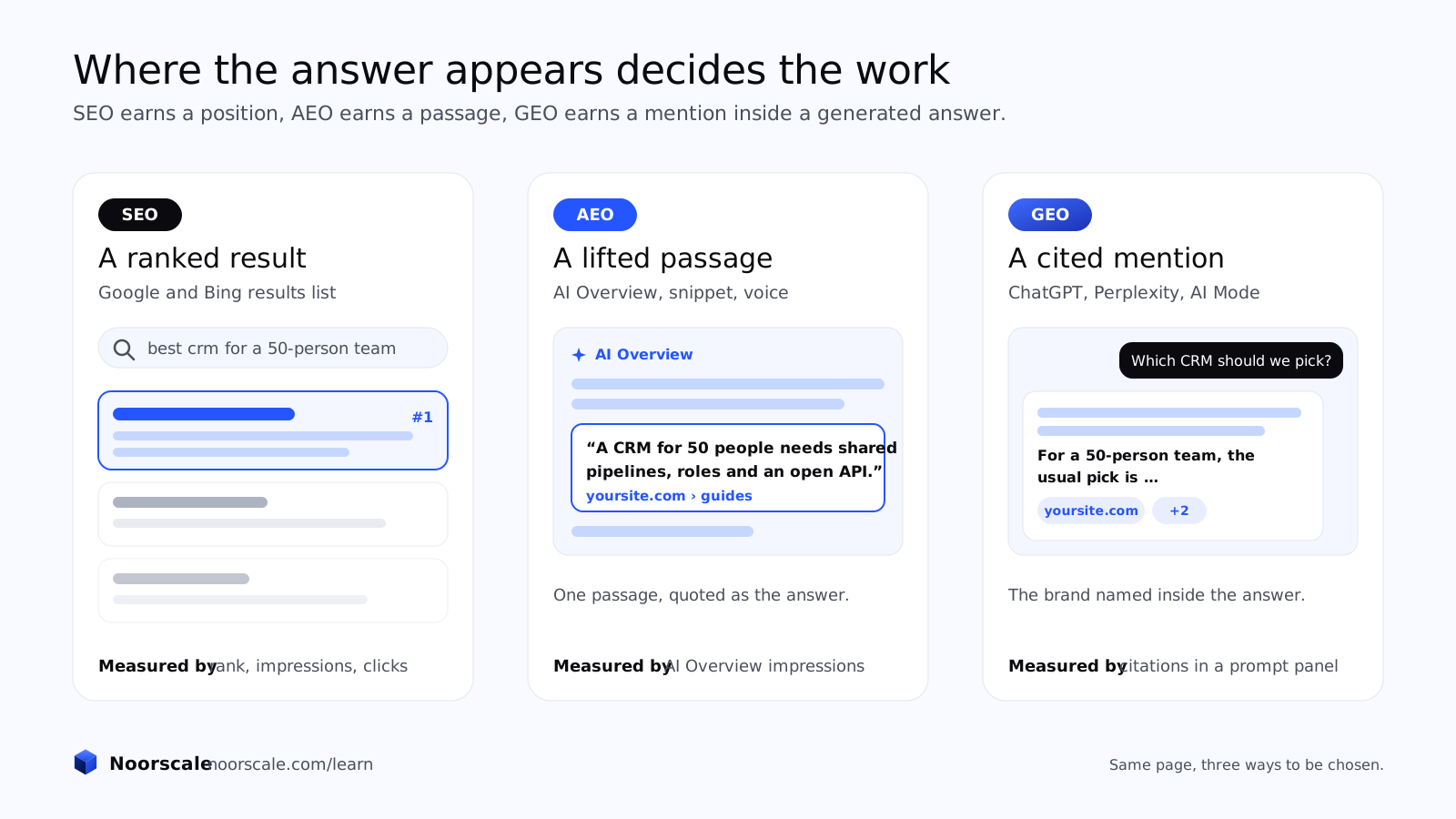
What is the difference between GEO, AEO and SEO?
The difference between GEO, AEO and SEO is the surface each one targets: GEO targets generated answers in ChatGPT, Perplexity, Gemini and Google AI Mode; AEO targets direct answers such as AI Overviews, featured snippets and voice results; SEO targets ranked results in Google and Bing. If you've sat through a pitch where all three were sold as separate products, you were right to be suspicious. They share the same raw material, which is a crawlable page that answers a question well and a brand that other sites mention. They differ in how that page is chosen and in what counts as success, and that difference is what the table below is for.
| SEO | AEO | GEO | |
|---|---|---|---|
| Surface | Ranked results in Google and Bing | Direct answers: AI Overviews, featured snippets, People Also Ask, voice | Generated answers: ChatGPT, Perplexity, Gemini, Google AI Mode |
| How the source is chosen | Ranking systems score pages for a query | A passage is lifted from an indexed page that answers the question directly | The engine runs several searches, retrieves passages and keeps the ones it trusts |
| Unit of success | A position | A quoted passage | A citation or a brand mention inside the answer |
| Typical work | Technical health, content, internal links, links from other sites | Answer-first pages, question headings, structured data, clear entities | All of the SEO and AEO work, plus coverage of sub-questions, third-party mentions and freshness |
| How it is measured | Rankings, impressions and clicks in Search Console | Snippet and AI Overview impressions; clicks arrive as organic | A fixed prompt panel checked each month for citations and mentions |
| Who usually sells it | SEO agencies and tools | SEO agencies, under a new name | SEO agencies, GEO agencies and AI visibility tools |
What is generative engine optimization (GEO)?
Generative engine optimization is the practice of making a brand's pages, data and mentions the sources that large language model answers cite and recommend. The term is younger than it sounds. It comes from the paper "GEO: Generative Engine Optimization" by Pranjal Aggarwal and colleagues at Princeton, Georgia Tech, the Allen Institute and IIT Delhi (2023, presented at KDD 2024), which tested adding citations, statistics and quotations to pages and measured how often a test engine used them. The engines it now covers are ChatGPT, Perplexity, Gemini, Claude and Google AI Mode. One thing worth knowing before you put the word in a budget line: searches for "generative engine optimization" peaked in mid-2025 and have fallen since, while searches for "AI SEO" have grown, by the estimates MarketSplash and seodata.dev published in 2026. People are keeping the work and dropping the label.
What is answer engine optimization (AEO)?
Answer engine optimization is the practice of structuring a page so a search engine or assistant can lift one passage as the direct answer to a question. Its surfaces are AI Overviews, featured snippets, People Also Ask boxes and voice assistants. Google's own guidance in "AI features and your website" (Search Central, 2025) says there are "no additional requirements to appear in AI Overviews or AI Mode" beyond a page being indexed and snippet-eligible, and that no special structured data is needed. That line matters if someone has told you that you need a new kind of markup to show up. You don't. AEO is the discipline of being the clearest answer on an indexed page.
What is search engine optimization (SEO) in 2026?
Search engine optimization is the practice of earning ranked positions in Google and Bing through crawlable pages, relevant content, and links and mentions from other sites, and in 2026 it is also the base that AI citations are selected from. Perplexity's cited domains overlap the Google top 10 more than 91% of the time (Semrush, AI Mode comparison study, July 2025). ChatGPT search surfaces pages through its own crawler, OAI-SearchBot, and draws on Bing's index (OpenAI, bot documentation; OpenAI's VP of Engineering in a November 2024 Reddit AMA). So if your SEO has felt like a cost centre lately, here is the reframe: a page that cannot rank anywhere is rarely retrieved by anything.
How do AI engines choose which pages to cite?
AI engines choose pages to cite by running several searches for the sub-questions behind a prompt, retrieving passages from indexed pages, and keeping the passages that answer directly and come from sources the engine already trusts. The steps are the same across engines even though the indexes differ, and once you can picture them, most of the advice you've heard sorts itself into "helps" and "doesn't".
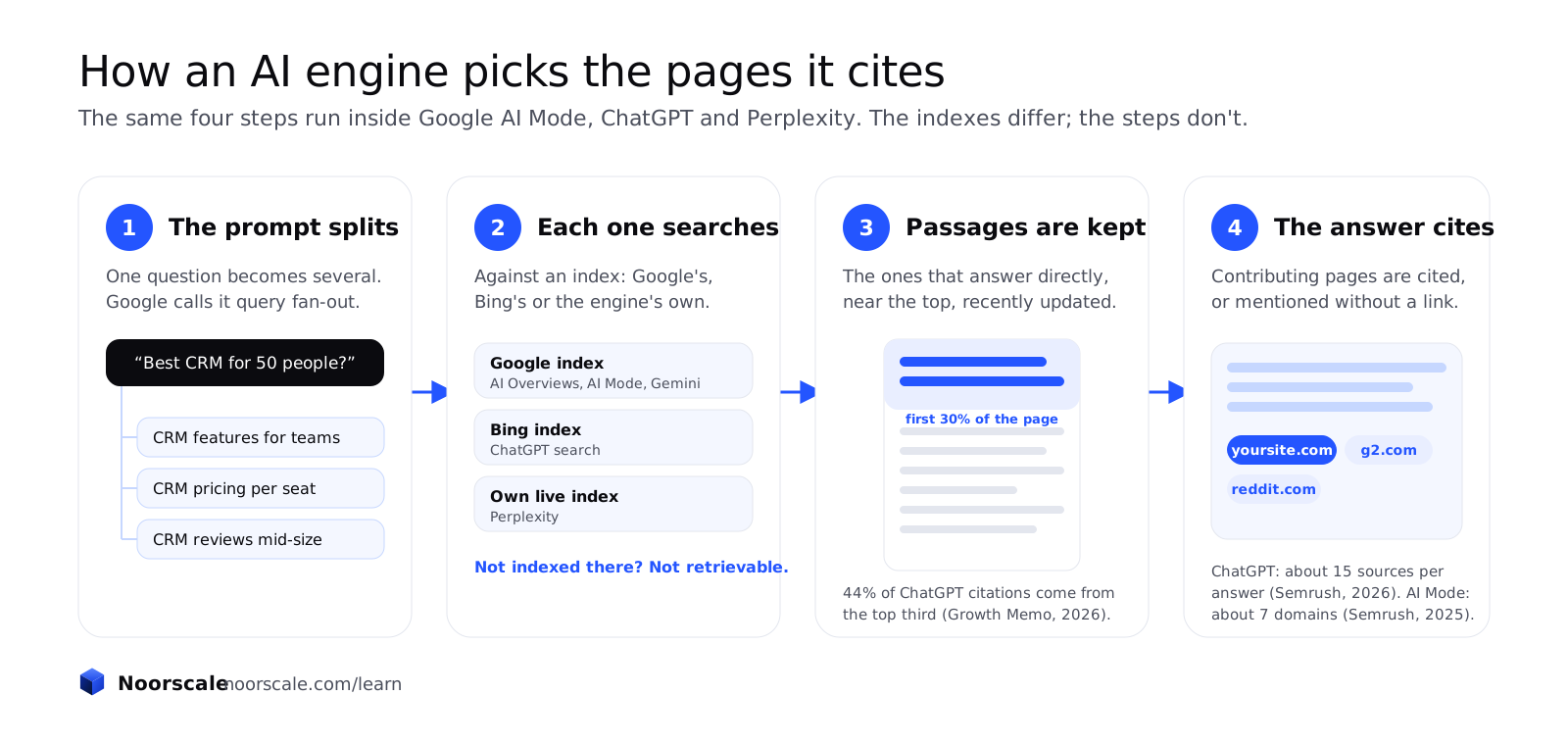
The four steps every answer engine takes between a prompt and a citation are these.
- Prompt decomposition: the engine breaks the prompt into sub-questions, which Google calls query fan-out.
- Retrieval: each sub-question runs as a search against an index (Google's, Bing's or the engine's own) and returns candidate pages.
- Passage selection: the engine keeps the passages that answer a sub-question directly, which favors text near the top of a page and pages updated recently.
- Citation: the answer is written from those passages, and the pages that contributed are cited or, in ChatGPT's case, often mentioned without a link.
Google's engines and the others differ in the index they search and in how much they lean on rankings, which the next two sections cover. The full mechanism for Google is in how Google AI Overviews and AI Mode choose their sources.
How do Google AI Overviews and AI Mode pick sources?
Google AI Overviews and AI Mode pick sources with query fan-out, issuing multiple related searches across subtopics and selecting indexed, snippet-eligible pages from those results. Google's documentation says both features "may use a query fan-out technique" and that AI Mode is "rooted in our core quality and ranking systems" (Google, AI Mode launch post, 2025). Rankings still matter, but less than they did, and this is the number to keep for the next time someone says "just rank and you'll be cited": 76.1% of AI Overview citations ranked in the top 10 in July 2025 (Ahrefs, 1.9 million citations), and 38% did by March 2026 after the Gemini 3 upgrade to AI Overviews (Ahrefs, 863,000 keywords). AI Mode goes further afield still.
| AI Overviews | AI Mode | |
|---|---|---|
| Domains cited per answer | About 3 | About 7 |
| Cited pages that rank in the top 10 | 38% (March 2026) | About a third of URLs; about half of domains |
How do ChatGPT and Perplexity pick sources?
ChatGPT picks sources through its search crawler, OAI-SearchBot, and a web index it shares with Bing, while Perplexity runs its own live search whose cited domains overlap the Google top 10 more than 91% of the time. The two engines also trust different kinds of site, which is why a brand can be everywhere in one and invisible in the other. In Profound's analysis of about 680 million citations (June 2025), ChatGPT's most-cited domain was Wikipedia and Perplexity's was Reddit. In Surfer's September 2026 list of ChatGPT's 50 most-cited domains, the review directories Clutch and G2 sat second and third. If you sell services, that last fact is probably the cheapest win on this page. The detail on crawlers, Bing and directories is in how ChatGPT chooses sources.
Is GEO just SEO with a new name?
No, GEO is not just SEO with a new name, but about four fifths of the work is the same. Peter Rota, a senior technical SEO manager who audits sites for AI visibility, put it this way on the Noorscale podcast: "If you have a basic foundation of SEO, you're going to get 80% of the way there." The sceptics have a point too, and you've probably met one. A widely shared thread on Reddit's r/SEO in April 2026 argued that "most GEO experts are SEO consultants who changed their LinkedIn bio", and the search data agrees that the label is losing ground. What survives the scepticism is the last fifth: the parts of the work that SEO never measured, which the evidence below separates from the parts it always did. The full test record is in whether generative engine optimization works.
What does the evidence say about GEO tactics?
The evidence on GEO tactics is mixed: the original 2023 paper found that adding citations, statistics and quotations raised visibility in its test engine by roughly 30 to 40%, while a 2026 practitioner test reported by Ahrefs found that optimized pages were cited 10.9 to 12.2% of the time against 13.3% for untouched pages. Both results are real. They were just measured in different places, and the table is here so you can see that for yourself rather than take anyone's word for it.
| Study | Sample | What it looked at | Finding | Date |
|---|---|---|---|---|
| Aggarwal et al., GEO (Princeton and others) | Benchmark of 10,000 queries, test engine | Adding citations, statistics, quotations | Visibility up roughly 30 to 40% in the test engine | 2023 |
| Jan-Willem Bobbink, reported in Ahrefs' AI search trends | One page, three engines | The same three tactics on a live page | Optimized versions cited 10.9 to 12.2%; untouched 13.3% | July 2026 |
| Ahrefs, brand correlation study | 75,000 brands | What correlates with AI Overview visibility | Branded mentions 0.664; backlinks 0.218; domain rating 0.326 | May 2025 |
| Seer Interactive, recency study | 47,097 citations | How recently cited pages were updated | 75% updated within a year; Gemini 78%, ChatGPT 73% | July 2026 |
| Growth Memo via Search Engine Land | 18,012 ChatGPT citations | Where on the page the cited text sits | 44% of citations from the first 30% of the page | 2026 |
| Ahrefs, AI Overview citations | 1.9M citations, then 863K keywords | Overlap with top-10 rankings | 76% in July 2025; 38% in March 2026 | 2025 to 2026 |
Read together, the tactics that hold up are the ones that are also good SEO: pages that rank, a brand that other sites mention, pages that are kept current, and answers that sit near the top. The tactics that were supposed to be special to GEO, such as sprinkling statistics into an existing page, have the weakest record. If that's what you were quoted for, you can ask for the money back.
What changes in practice when you optimize for AI answers?
In practice, optimizing for AI answers changes four things: the page opens with the answer, the site covers the sub-questions an engine fans out to, the brand is mentioned on third-party sites the engines trust, and pages are updated rather than only added. Everything else carries over from SEO unchanged, which is good news if you've already paid for the SEO.
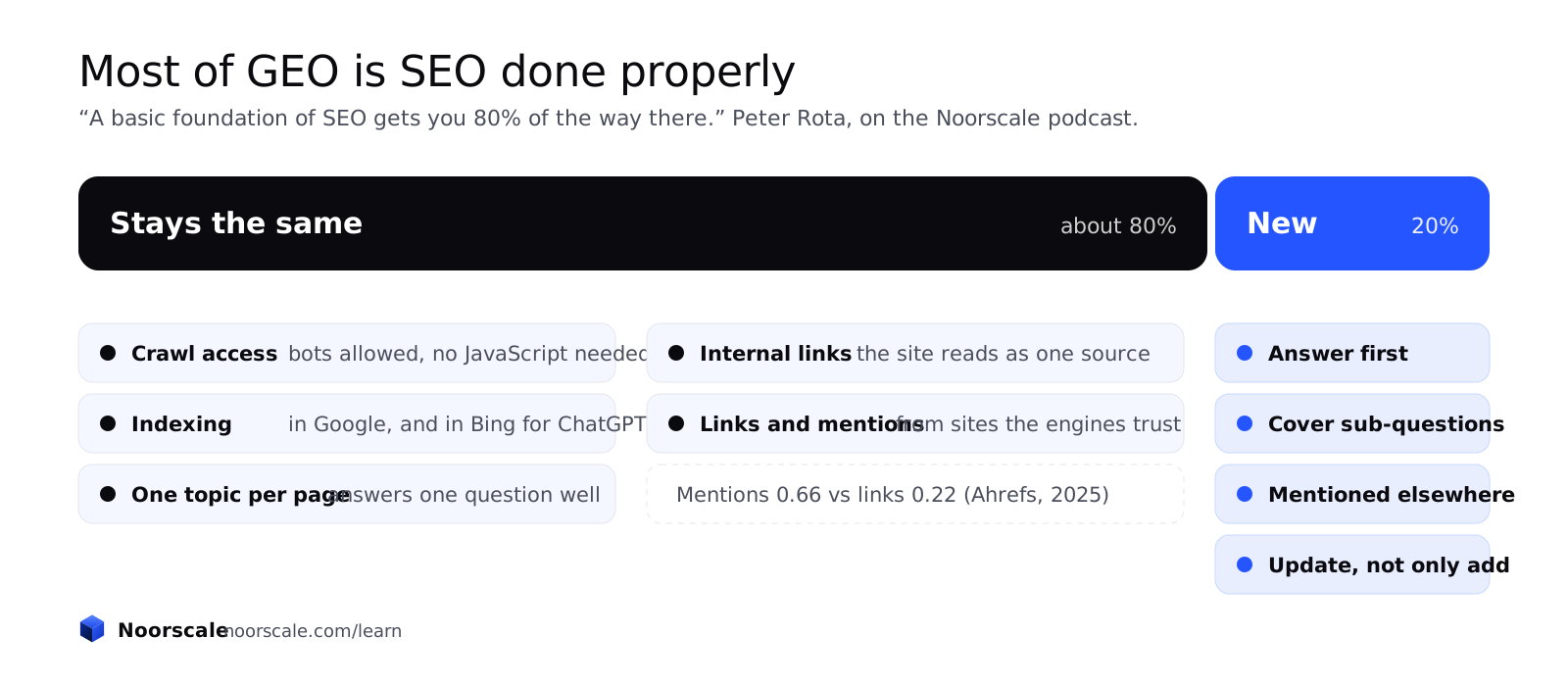
What stays the same between SEO and GEO?
What stays the same is everything that makes a page eligible: crawl access, indexing, a clear topic per page, internal links, and links and mentions from other sites.
The work that SEO and GEO share is the larger part of both.
- Crawl access for SEO and GEO: the page is reachable, renders without JavaScript, and is not blocked for the crawler that matters (Googlebot, Bingbot, OAI-SearchBot, PerplexityBot).
- Indexing for SEO and GEO: the page is in the index the engine searches, which for ChatGPT means Bing as well as Google.
- One topic per page for SEO and GEO: a page that answers one question well is retrieved for it; a page that touches ten is retrieved for none.
- Internal links for SEO and GEO: the pages on a topic point to each other, so the engine reads the site as a source on it.
- Mentions and links from other sites for SEO and GEO: the strongest single correlate of AI visibility in the Ahrefs data is being named elsewhere.
What is new in GEO and AEO work?
What is new is the unit of success: a passage cited inside an answer rather than a page ranked on a results list, which rewards answer-first writing, coverage of the whole topic, mentions over links, and freshness. In Growth Memo's analysis of 18,012 ChatGPT citations, 44% of the cited text came from the first 30% of the page, so the answer has to be at the top, not built up to. That one habit is uncomfortable for writers who were taught to warm the reader up, and it is the single edit that pays back fastest. Several 2026 analyses report that sites organized in topic clusters are cited more often in AI Overviews, which is the same idea as topical authority in semantic SEO: cover the questions around a topic, not only the head term. And because the Seer data shows three quarters of cited pages were updated within a year, a publishing calendar matters less than an updating calendar.
How is GEO measured compared with SEO?
GEO is measured by how often a brand is cited or mentioned across a fixed set of prompts, while SEO is measured by rankings, impressions and clicks in Search Console. The two cannot be read from the same report, and some of GEO cannot be read from any report yet. If you've asked for an AI traffic number and received a shrug, that is why, and the shrug was the honest answer.
| Metric | SEO | GEO |
|---|---|---|
| Visibility | Impressions and average position in Search Console | Cited or mentioned in a fixed panel of prompts, checked monthly |
| Traffic | Clicks in Search Console; sessions in analytics | Referrals from chatgpt.com, perplexity.ai and gemini.google.com in analytics; AI Overview clicks arrive as ordinary organic clicks |
| AI Overviews and AI Mode | Not separated | The Search Console "Search Generative AI" report (June 2026) shows impressions only, with both features combined |
| Brand | Branded search volume | Branded search volume, plus how the engines describe the brand when asked |
The honest version of a GEO report has three lines: cited prompts out of the panel, AI referrals in analytics, and branded search. Anyone offering you a fourth line is estimating. The rest is in how to measure AI Overview, AI Mode and ChatGPT traffic.
Which should a business invest in first: SEO, AEO or GEO?
A business should invest in SEO first when it has no rankings, in AEO when it ranks but is not quoted, and in GEO when buyers in its category already ask assistants for recommendations. The starting position decides the first move. You don't need all three at once, and nobody who tells you otherwise has looked at your Search Console.
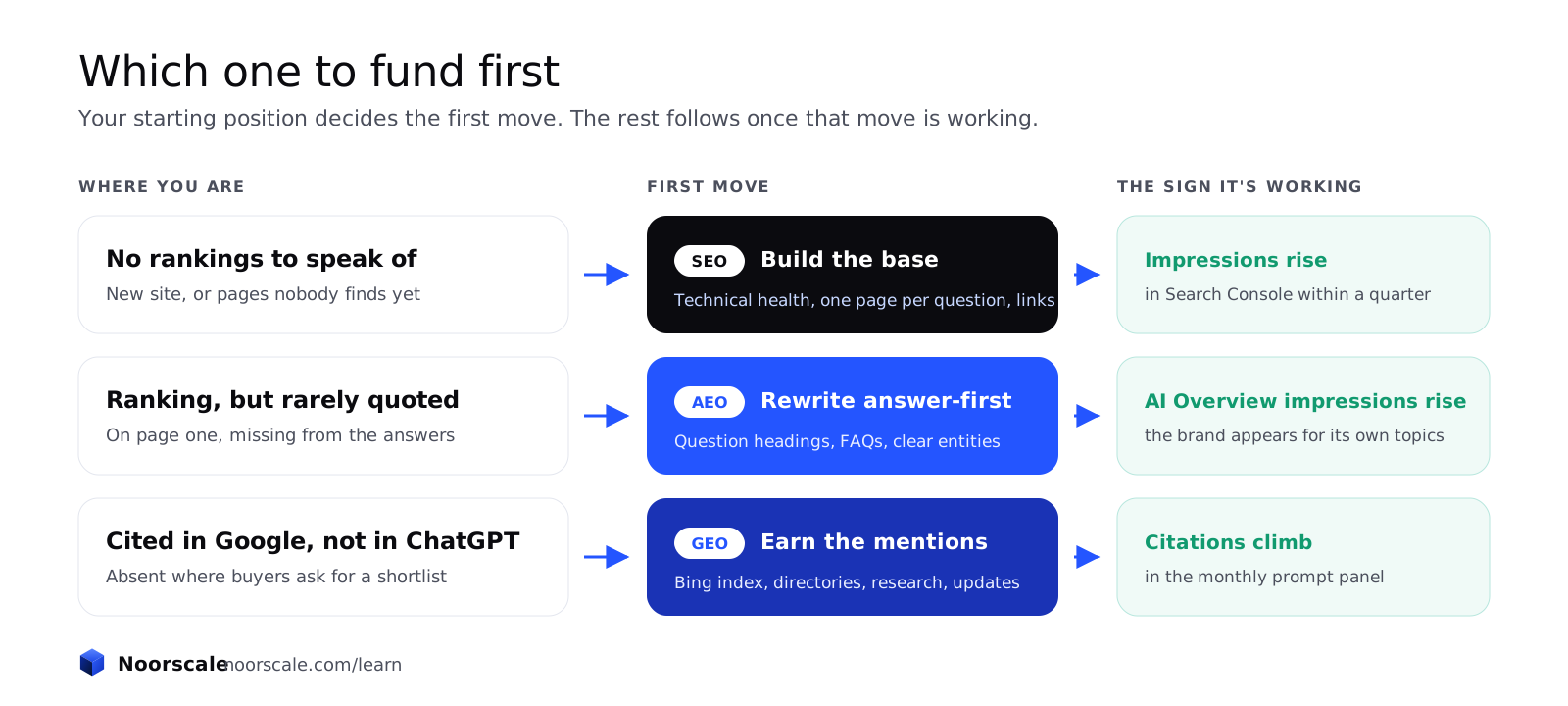
| Starting position | First move | The sign it is working |
|---|---|---|
| No rankings to speak of | SEO: technical health, one page per question, internal links, a few earned mentions | Impressions rise in Search Console within a quarter |
| Rankings, but rarely quoted | AEO: rewrite the top pages answer-first, add question headings and FAQs, fix entities | AI Overview and snippet impressions rise; the brand appears in answers for its own topics |
| Cited in Google, absent in ChatGPT and Perplexity | GEO: Bing indexing, directory listings such as Clutch and G2, third-party mentions, original research, an updating calendar | The monthly prompt panel shows citations climbing engine by engine |
Should a SaaS or e-commerce company start with GEO?
Yes, a SaaS or e-commerce company with existing rankings should start with GEO, because buyers in both categories ask assistants for comparisons and recommendations, and product and category pages are among the formats AI engines cite most. In the Wix Studio AI Search Lab study with Peec (2026, over one million citations), product pages took 13.7% of all citations, behind listicles at 21.9% and articles at 16.7%. A SaaS company's comparison pages and an e-commerce company's category pages are already the right shape; the GEO work is making them answer-first and getting them mentioned elsewhere.
Should a local or multi-location business start with AEO?
Yes, a local or multi-location business should start with AEO, because its buyers ask direct questions with a place or a service in them, and those are answered from a single well-structured page, a complete Google Business Profile and consistent listings. The assistants lean on the same sources for local questions that Google does, so a location page that answers "do you take walk-ins" and "how much does a first visit cost" in its first lines does double duty. GEO for a local business is mostly AEO plus reviews.
How much do GEO, AEO and SEO cost, and how long do they take?
GEO, AEO and SEO cost about the same per month at an agency, because they share most of the work; the difference is in what is measured and how soon it shows. Agencies price all three as a monthly retainer scoped to the number of pages, the competition and how much third-party work is needed, with AEO and GEO often sold as an add-on to an existing SEO program rather than a separate one. If a quote for GEO is several times your SEO quote, ask what the extra pays for; the answer should be mentions, research and measurement, not a new name for the same pages.
| SEO | AEO | GEO | |
|---|---|---|---|
| Pricing model | Monthly retainer, scoped by pages and competition | Add-on to SEO, or a one-off rewrite of the top pages | Add-on to SEO, scoped by prompt panel size and third-party work |
| What drives cost | Technical debt, content volume, link and mention outreach | Number of pages rewritten answer-first | Mentions, directory work, original research, monthly measurement |
| First measurable change | Impressions in a quarter; rankings in 3 to 6 months | Snippet and AI Overview impressions in 4 to 8 weeks after a rewrite, as several 2026 sources report | Citations in 4 to 8 weeks for structure changes; head-term prompts take months |
Noorscale scopes every engagement in writing before quoting it, and no agency can promise a citation, a ranking or a date. What the scope for AI search optimization does promise is the list of pages, mentions and measurements the retainer buys, so you can hold it to that list.
How does Noorscale combine SEO, AEO and GEO?
Noorscale runs SEO, AEO and GEO as one program: a semantic topical map for coverage, answer-first pages for extraction, third-party mentions for trust, and a monthly prompt panel for measurement. The method comes from the founder's training in semantic SEO (a Semantic SEO Expert Certificate recognized by Koray Tuğberk GÜBÜR, March 2024) applied to the way answer engines now retrieve pages. The program doesn't separate the three into packages, because the page that ranks, the passage that gets lifted and the mention that gets the brand recommended are built in the same month by the same people. SEO and AI search services describes what a month of it contains.
What should you do this week?
This week, do one thing: open ChatGPT, Perplexity and Google AI Mode, ask each the question your best customer asked before they found you, and write down who gets named. That is your starting position, and it takes twenty minutes. If you're named nowhere, the page above tells you which move is first. If you're named in one and not the others, you already know which gap to close.

Comments
Disagree with something, or have a case this page doesn't cover? Noor reads every comment and replies to the ones that add something, here on the page. Your email is never shown.